
Why We Built a 5-Point Rubric for CDL Training Proficiency
June 24, 2026
When we set out to solve the proficiency documentation problem in CDL training, the first question wasn't what to track. It was how to grade. Without a grading system that can show progression over time, you don't really have a proficiency story. You have a snapshot of one moment, and a snapshot doesn't hold up when someone asks you to explain a trainee's journey.
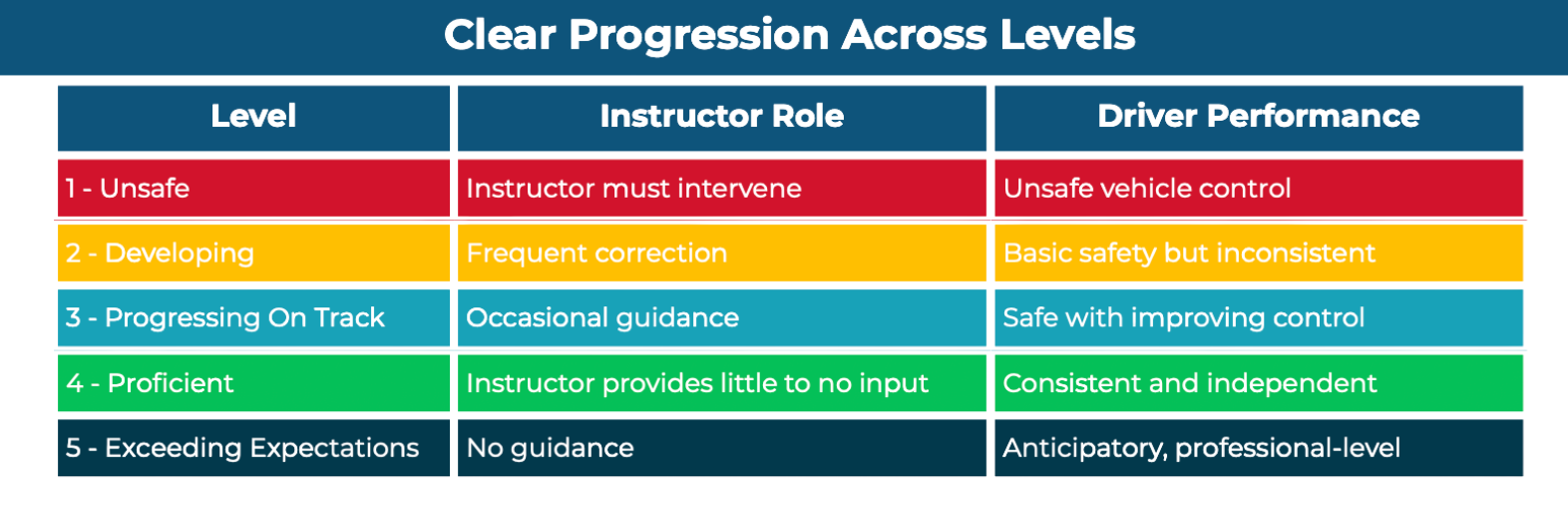
So we built a 1-to-5 rubric, and every level means something specific.
1 is "Unsafe." The student requires instructor intervention. They're having difficulty maintaining control, failing to hold lane position, grinding gears, or showing poor awareness of their surroundings. This isn't a student who's struggling to improve. This is a student who shouldn't be behind the wheel without active supervision.
2 is "Developing." This student is generally safe to put in traffic but needs consistent guidance and correction. They're meeting some criteria, making progress, but not operating consistently enough to be on their own yet.
3 is "Progressing On Track." It's one of the levels we thought most carefully about including. This student generally meets the criteria with occasional reminders, makes minor mistakes but corrects them with minimal instruction, and operates safely with minimal guidance. They're on a clear path to proficiency. A 3 in a student's record isn't a problem. It's documentation of a real stage in their development, and that's exactly what makes the overall story credible when someone asks to see it six months later.
4 is "Proficient." This student consistently meets performance criteria without reminders, recognizes and corrects minor mistakes on their own, operates smoothly and confidently, and requires little to no instructor input. When a student reaches a 4 across the required skills, they're ready to be certified.
5 is "Exceeding Expectation."
We added this level deliberately because it reflects something real that happens in training. This student operates with full independent control and no instructor input at all. More than that, they anticipate traffic conditions and adjust before situations develop. They're not just meeting the standard. They're performing at a professional level. A 5 isn't required for certification, but it's documentable, and carriers putting new drivers on public roads from day one notice the difference.
We score each skill area separately: vehicle controls, shifting and transmission, communications and signaling, visual search, speed and space management, and safe driver behavior. A student can be strong in one area and still developing in another. Scoring each unit on its own makes those gaps visible before certification, not after.
Every skill area maps to the required curriculum units under 49 CFR Part 380, so when an instructor scores a student on categories such as upshifting, hazard perception, or railroad crossing procedure, that score directly corresponds to the regulatory requirement it satisfies. The loop between trained and proven gets closed.
The documentation bar for CDL training has moved permanently. What answers the question FMCSA is asking is a dated, skill-by-skill record showing where a student started, how they progressed, and where they finished, with an instructor's name and signature on every assessment. That's the proficiency story. The rubric is what makes it tellable.