
Can You Answer the Question FMCSA Is Asking?
June 23, 2026

What auditors are really asking for is the proficiency story.
The Certificate Is Not the Whole Story
When an auditor shows up at your school, they aren't going to ask how many students you graduated last year. They're going to pull up the TPR student file and ask you to show them how you knew that particular student was proficient before you certified him. If your answer is the completion certificate itself, you’ve got the last back cover of the book but are missing the rest. This is where we have seen the biggest gap for training providers.
What auditors are really asking for is the proficiency story. Not just whether the student finished, but how they got there: where they started, what skills they struggled with, what improved, who verified it, and when they finally performed each required skill to standard. If that story is not in the file, the school may have made the right call, but it has no way to prove it later.
Why the Rule Focuses on Proficiency
It helps to remember why the rule reads the way it does. When FMCSA wrote the entry-level training requirements, it declined to set a minimum number of behind-the-wheel hours. People still get tripped up by that. They assume "no minimum" means get them in and out as fast as possible, when it means almost the opposite. The agency decided hours were the wrong thing to count, and what it wants instead is proof that the student can actually do the job, demonstrated and documented by the instructor before any student can graduate.
So picture that file on the table again. A completion certificate tells the auditor that the student reached the end of your course. It tells them nothing about whether he could back into a tight dock, hold his space in traffic, or recover when something went wrong on the road. It doesn't say whether the instructor watched him do those things cleanly five times or signed the form because it was the end of a long week. The certificate is a snapshot of a finish line. Proficiency is the whole run-up to it, and you can only prove that happened if someone wrote down how it went while it was going.
What “Telling the Proficiency Story” Means
That's really all "telling the proficiency story" means.
Where did this student start? The man who has been driving equipment his whole life and the one who'd never touched a clutch have different starting points.
How did each one come along over the weeks, the skills they wrestled with and the ones that finally clicked, the point where they stopped needing a prompt and just did it right?
And at the end, can you point to the moment he performed each required skill to standard, with a date and a name on it?
String those together, and you've got something an auditor can't argue with. Skip them, and you've got a piece of paper.
The instructor's judgment lived in their head and on a clipboard that got tossed at the end of the day so when the question finally came, there was nothing to hand over. They didn't fail at training. They failed at documentation.
The Problem With Pass/Fail
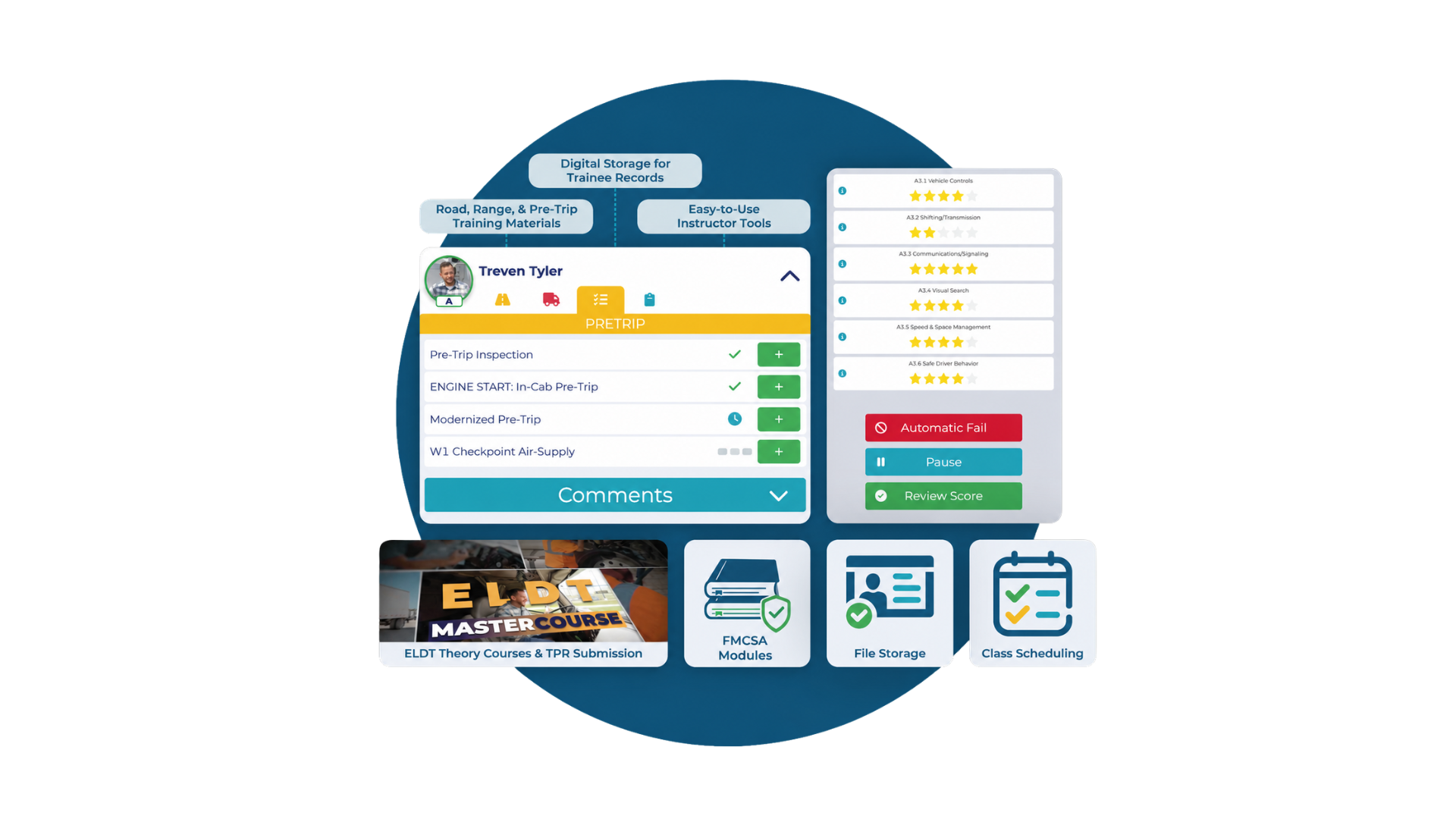
Underneath all of this, most schools have a grading problem they've never named. They grade proficiency the way you'd grade a road test: pass or fail, did it or didn't. The trouble with pass/fail is that it flattens everybody. Every student you certify ends up looking identical on paper, and identical is the one thing that's useless to the people now asking to see your records. They don't want to just know that they passed. They want to know how they got there.
You can't get there with a checkmark. You get there with a record that can show movement, a student who started shaky on his backing and, over several sessions, climbed to doing it right on his own. Which raises the fair question: what counts as good enough to call "proficient"? It feels like the rule leaves you guessing on the behind-the-wheel side, because it doesn't print a number the way it does for the theory test. But there's a defensible answer sitting in the same regulation, if you know which standard to borrow and how to apply it the same way every time. Get that part right and proficiency stops being one instructor's gut feeling and becomes something you can defend to anyone who walks in the door.
The Record Behind the Grade
The grade is only half of it, though. The other half is the record behind each grade, and that's more than a date. Every time a skill gets assessed, you want it tied to the student, the instructor, and the exact skill the way the regulation names it, with a signature, all answering one plain question: did this student show proficiency? Do that consistently and you're building an audit proof file in real time. The file built itself and the morning the notice audit arrives is just another Tuesday.
The same records support other stakeholders as well. The carrier looking at your graduate wants to know whether he's worth hiring. The insurer standing behind that carrier wants to know whether he's worth covering, and in this market they can't afford to gamble on a green driver they can't read. One documented proficiency story answers all three at once. The graduate who shows up with proof gets the job, and the school that sent him out with it gets the next class, because placement is the first thing every prospect asks about.
The Shift Schools Need to Make
None of this is more teaching. It's holding onto the call your instructors already make, in a form that's still there six months later when someone asks to see it. That's the whole shift, and it's smaller than it sounds. The schools that will stand up over time are the ones that can prove, skill by skill, how each student became ready to drive.