
First Day or Tenth Year, Instructor Standards Should Match
July 20, 2026
Every school owner has seen some version of this. A veteran instructor who has been teaching since before ELDT existed runs the range his way because his way works. A new instructor, two weeks in, teaches what he remembers from his own training. Both are putting in an honest effort. And both are quietly running two different programs under one school’s name.
The student who trains under the veteran gets one experience. The student who trains under the new hire gets another. When those two students graduate, their records say they completed the same program. They did not.
Whether it is an instructor’s first day or they have been there for ten years, the content they teach should be the same. That is the standard. Getting there takes more than simply telling people to be consistent.
When Was the Last Time Your Instructors Saw the Curriculum?
Most schools have a curriculum. It lives in a binder in the office or on a shared drive somebody set up years ago. The instructors saw it during onboarding, and that is usually the last time they saw it.
Nobody carries a training manual around the range. Nobody flips through a binder in the passenger seat while a student is backing a trailer. We know that would be impractical. So instructors do what anyone would do: they teach from memory.
The veteran teaches from twenty years of habit. The new hire teaches from whatever stood out during their first two weeks. The curriculum everyone agreed on sits on the shelf while the actual training drifts, one instructor at a time.
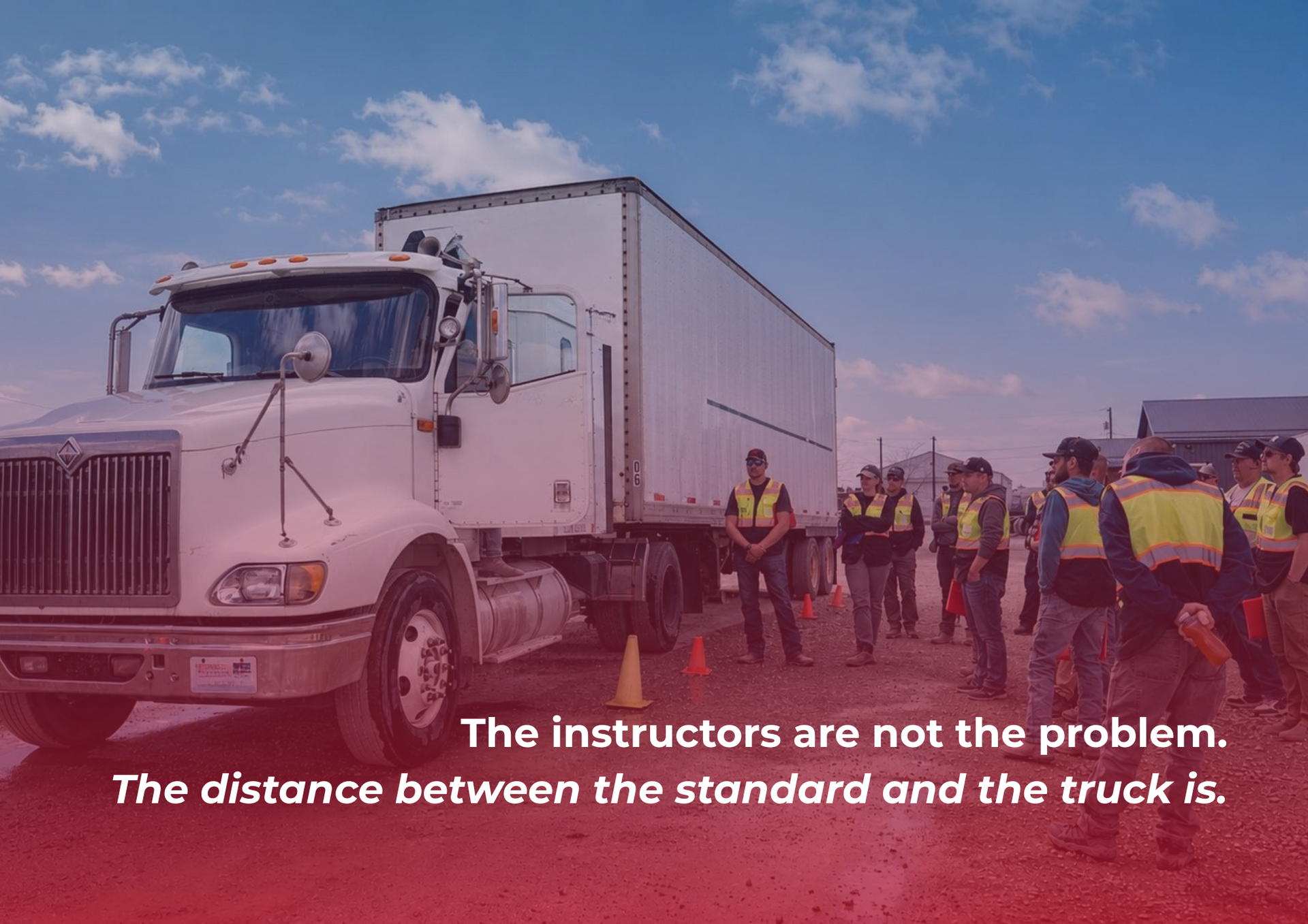
The instructors are not the problem. The distance between the standard and the truck is the problem.
Put the Standard Where the Work Happens
The fix is simple to describe: an instructor should be able to check what they are training on in the moment, without having to hunt for it.
If an instructor is about to take a student through lane changes, they should be able to see within seconds what that unit covers and what they should be watching for. Not from memory. Not from a binder back in the office. Right there, where the training is happening.
Some schools do this with notecards. Some do it with software. If an instructor can quickly check exactly what they need to cover and how they should score a student, that is a no-brainer. The method matters less than the principle. The standard has to travel with the instructor into the truck instead of staying behind on a shelf.
We built the instructor manual directly into the instructor portal for exactly this reason. When an instructor pulls up a student, the content for that unit is available on the same screen. A quick look answers three questions: What am I teaching? What am I watching for? What does this student still need?
The veteran and the first-day hire are reading from the same page because the page is right in front of both of them.
Consistency Is What Protects Your Instructors
There is another side of this issue that often gets missed. Standardizing what instructors teach is not about controlling them. It is about protecting them.
If a graduate’s training is ever questioned, whether by an auditor, a carrier, or, worse, a lawyer after an accident, the instructor who signed off is the one whose judgment may be examined.
An instructor who was teaching from memory has only their word to stand on. An instructor who was teaching from a documented, school-wide standard has the entire program behind them. Their sign-off stops being a personal opinion and becomes the school’s established standard, consistently applied.
Veteran instructors sometimes bristle at additional structure. Framed this way, most of them come around because they realize they have been carrying that liability alone, often without anything in writing to support them.
One Program, Every Truck, Every Shift
A school with five instructors should be running one program, not five versions of it.
Students should receive the same training regardless of whose truck they climb into. Records should reflect a single standard regardless of who was teaching that day. And when someone asks how you know every student received the required training, the answer should be the same no matter which instructor they ask.
That is what standardizing the instructor side of your program actually gives you. It is not uniformity for its own sake. It is one program, taught to the same standard and supported by documentation from every seat in every truck you operate.
Want to see how CDL PowerSuite puts the instructor manual directly in the portal, where the training happens? Let’s talk.