
Modernized Basic Control Skills Test Overview
Jason Boudreau • March 10, 2025
The Basic Control Skills Test is a crucial part of obtaining your Commercial Driver’s License (CDL). It evaluates your ability to maneuver a commercial vehicle safely and accurately, testing skills essential for real-world driving scenarios.
In this article, we’ve compiled a series of stop-motion videos that break down each part of the BCS test—Forward Stop, Straight Line Backing, Forward Offset, and Reverse Offset—into simple, easy-to-follow steps. Alongside the videos, you’ll find detailed descriptions and practical tips to help you navigate each exercise with confidence.
Estos videos también están convertidos al español haga clic aquí para ver la traducción
Understanding the Test Structure
The Basic Control Skills Test is divided into four main exercises designed to assess your ability to control your vehicle in tight spaces and to judge its position relative to other objects. You must pass this test before moving on to the Road Test.
Components of the BCS Test:
- Forward Stop
- Straight-Line Backing
- Forward Offset Tracking
- Reverse Offset Backing
Each exercise tests specific skills and requires precision and control.
Scoring Criteria for the Basic Control Skills Test
The Basic Control Skills Test evaluates your ability to maneuver a commercial vehicle safely and accurately. The test consists of four exercises, each with specific scoring criteria based on performance in various areas. Points are deducted for pull-ups, encroachments, looks, and improper final positioning. Below is a detailed breakdown of the scoring criteria as outlined in the CDL Handbook.
Pull-ups
Definition:
A pull-up is when you move the vehicle forward during a backing exercise to adjust your position and avoid encroachments.
Scoring:
- Allowed Pull-ups:
- Exercise 2 (Straight-Line Backing): 1 free pull-up allowed.
- Exercise 4 (Reverse Offset Backing): 2 free pull-ups allowed.
- Penalties:
- Excessive pull-ups beyond the allowed free pull-ups result in point deductions.
- Stopping without changing direction is not counted as a pull-up.
Back-ups
Definition:
A back-up occurs when you move the vehicle backward during a forward-moving exercise to reposition yourself.
Scoring:
- Applicable Exercise:
- Exercise 3 (Forward Offset Tracking).
- Penalties:
- Each back-up during this exercise results in point deductions.
- No free back-ups are permitted.
Encroachments
Definition:
Encroachments occur when any part of your vehicle (except mirrors or high-mounted unique parts) crosses or touches the exercise boundary lines or cones.
Scoring:
- Penalties:
- Each instance of touching or crossing a boundary line results in point deductions.
- Unique parts above door mirror height (like a bucket truck) do not count as encroachments unless they are below mirror height.
Looks
Definition:
A “look” is when you exit the vehicle to check its position during a backing exercise.
Scoring:
- Allowed Looks:
- Exercise 2 (Straight-Line Backing): 1 free look allowed.
- Exercise 4 (Reverse Offset Backing): 2 free looks allowed.
- Penalties:
- Exceeding the allowed looks results in point deductions.
- Opening the door or moving from a seated position to look outside is also counted as a look.
- Opening the door while the vehicle is in motion may result in automatic failure.
Final Position
Definition:
Final position evaluates how well you align your vehicle within the designated boundaries at the end of each exercise.
Scoring:
- Penalties:
- Points are deducted if your vehicle does not finish within the boundaries or as instructed by the examiner.
- The vehicle must be straight and fully within the defined area.
Automatic Failures
Certain actions can lead to immediate failure of the test, regardless of the score.
Automatic Failure Criteria:
- Failure to Follow Instructions:
- Not complying with the examiner’s directions.
- Unsafe Acts:
- Examples include forgetting to set the parking brake, opening the door while in motion, or not maintaining three points of contact when exiting or entering the vehicle.
- Any action deemed unsafe by the examiner.
Layout of the Modernized Basic Control Skills Test:
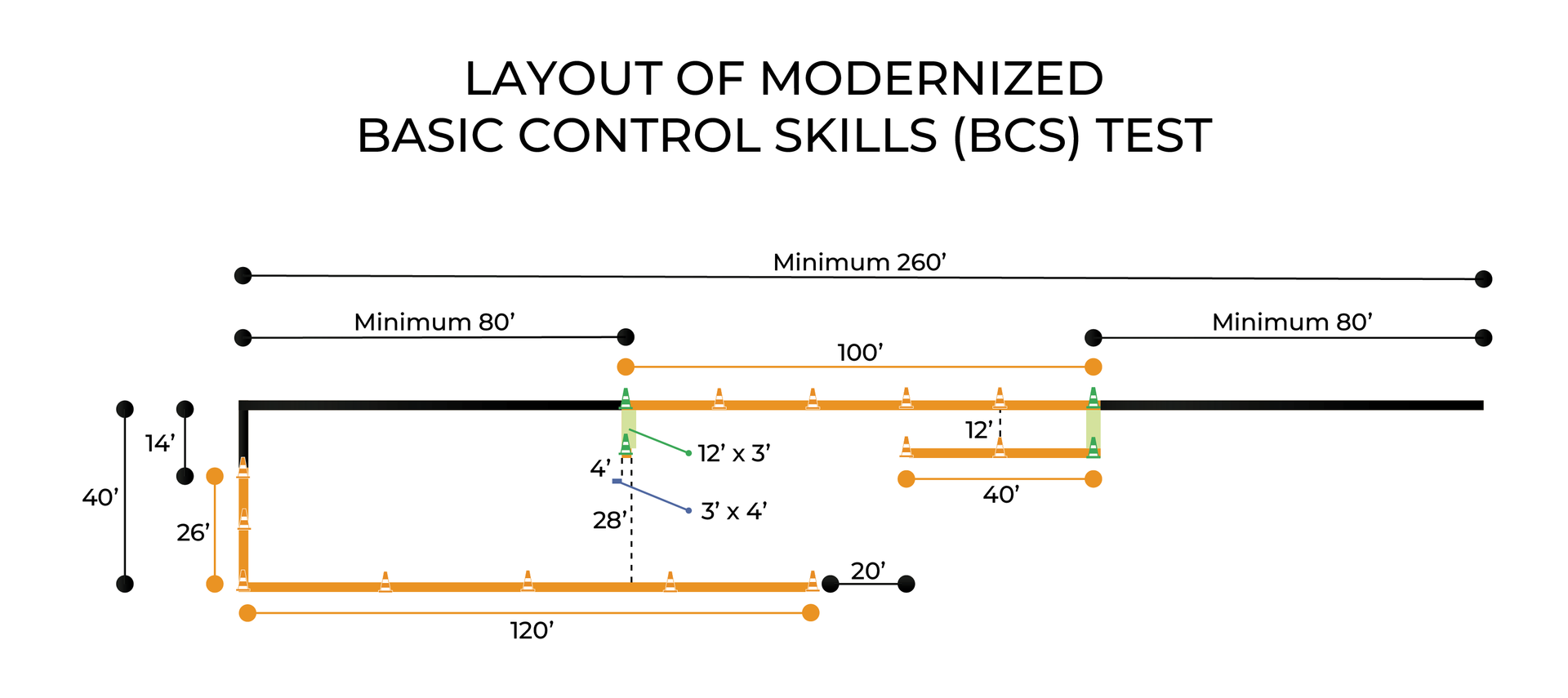
Forward Stop:
Modernized Basic Control Skills Test Exercise 1
Objective:
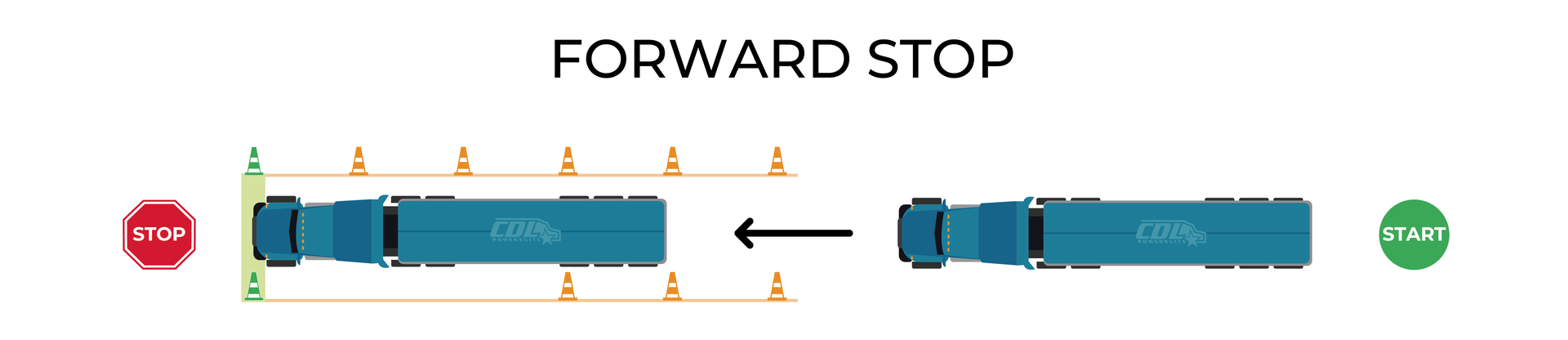
To assess your ability to judge the front end of your vehicle during a controlled stop.
- Starting Position: Begin before the first set of cones at the alley entrance.
- Pulling Forward: Move forward carefully and aim to place the frontmost part of your vehicle inside the stop box. You may stop only once.
- Completing the Maneuver: Once in the stop box:
- Set the parking brake
- Shift to neutral
- Sound your horn to signal to the examiner that you’re finished.
Straight Line Backing:
Modernized Basic Control Skills Test Exercise 2
Objective:
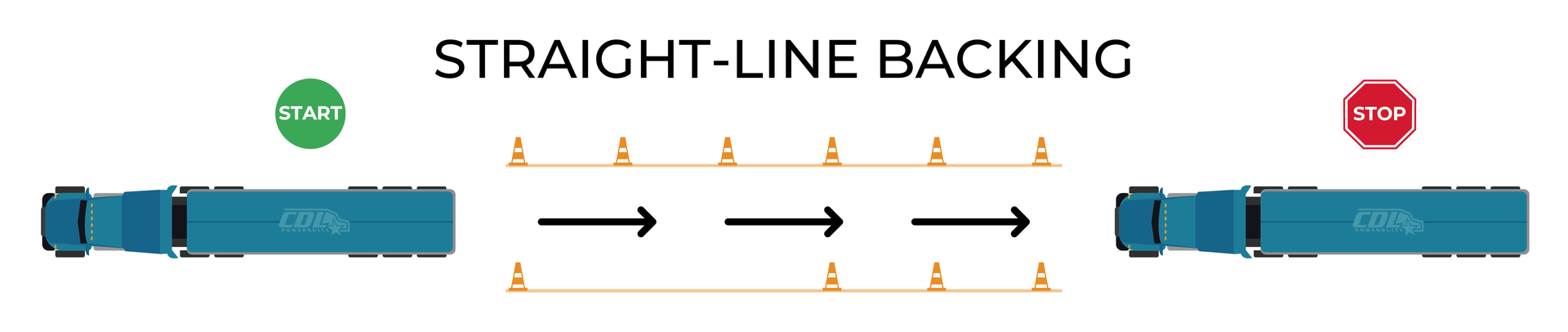
To evaluate your ability to reverse your vehicle in a straight line.
- Getting into Position:
After completing the forward-stop exercise, pull forward until your vehicle is outside the coned area at the end of the alley.
- Backing Up: Carefully back through the 100-foot alley:
- You’re allowed one get-out-and-look to check your position.
- You may also use one free pull-up if needed. Additional pull-ups will result in penalty points.
- Completing the Maneuver: Once you’ve backed through the alley:
- Set the parking brake
- Shift to neutral
- Sound your horn to signal the examiner that you’re done.
Forward Offset Tracking:
Modernized Basic Control Skills Test Exercise 3
Objective:
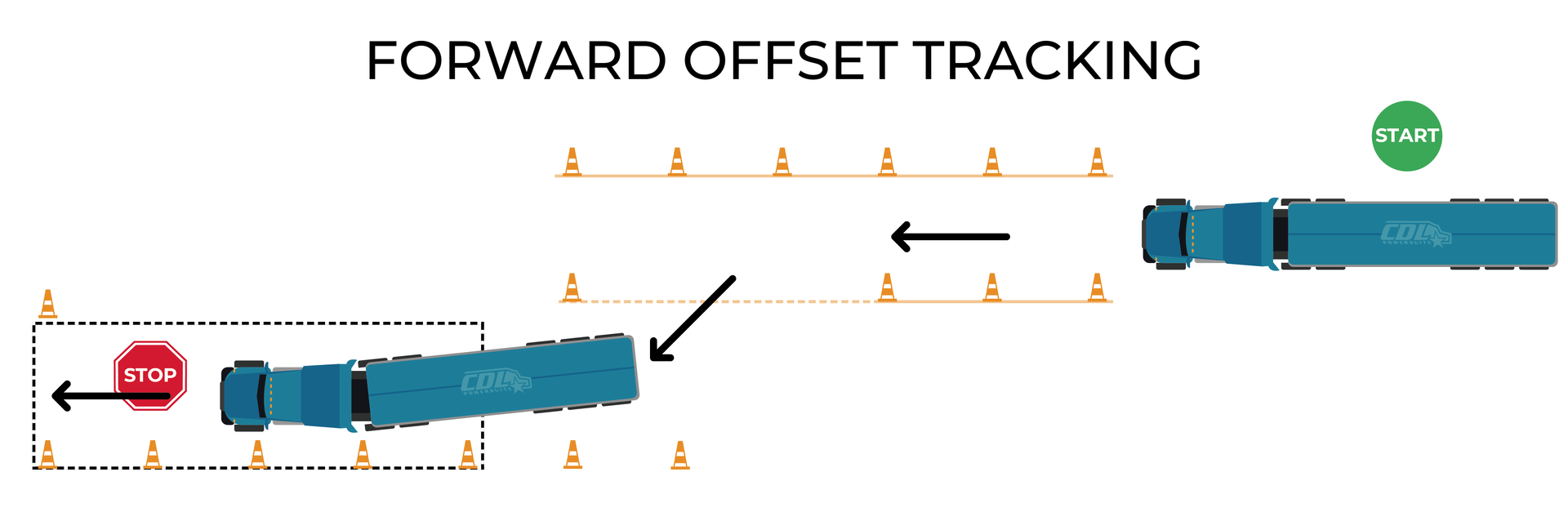
To test your ability to maneuver around obstacles while moving forward.
- Starting Position: Begin behind the cones at the alley entrance.
- Executing the Maneuver: Pull forward through the alley and steer to the left opening of the opposite lane:
- Keep the near-most axle of your vehicle within the two-foot mark that is four feet from the frontmost cone as you exit.
- Important: You cannot back up the vehicle without receiving penalty points. You may not exit the vehicle.
- Completing the Maneuver: Position your vehicle parallel with the outer boundary cones. Then:
- Set the parking brake
- Shift to neutral
- Sound your horn to signal the examiner that you’re done.
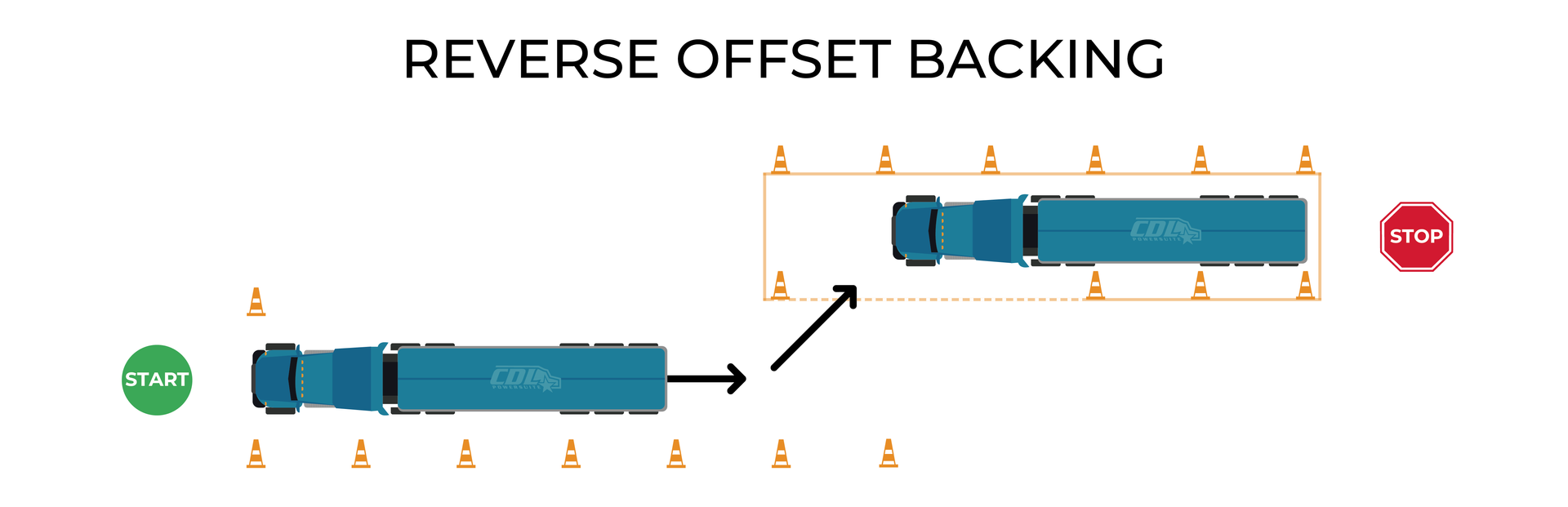
Reverse Offset Backing:
Modernized Basic Control Skills Test Exercise 4
Objective:
To assess your ability to offset back and park accurately within a confined space.
- Starting Position:
Begin parallel to the outer boundary cones.
- Executing the Maneuver: Back into the alley you pulled out of during the Forward Offset exercise:
- You’re allowed only two get-out-and-looks to check your position.
- You may also use two free pull-ups without penalty. Additional pull-ups will result in point deductions.
- Ensure the rearmost part of your vehicle ends up in the stop box.
- Completing the Maneuver: Once in position:
- Set the parking brake
- Shift to neutral
- Sound your horn to signal the examiner that you’re done.