
Understanding the Basic Vehicle Control (BCS) Skills Test
Jason Boudreau • February 7, 2025
The Basic Control Skills (BCS) test is a component of the Commercial Driver’s License (CDL) skills examination designed to assess a driver’s ability to maneuver a commercial vehicle in various controlled situations. This test evaluates essential driving techniques such as backing, turning, and stopping within specific boundaries to ensure the driver has the fundamental skills required for safe vehicle operation.
The BCS test typically includes exercises such as straight-line backing, offset backing, parallel parking, and alley docking, all of which are crucial for real-world trucking scenarios. These maneuvers test a driver’s ability to control their vehicle while maintaining spatial awareness, proper mirror usage, and precision in confined areas. Successfully completing the BCS test demonstrates that a driver has mastered the foundational vehicle control skills necessary for obtaining a CDL and operating commercial motor vehicles safely.
The Modernized BCS Test's Impact on Training
Despite the introduction of the modernized test, the FMCSA's Entry-Level Driver Training (ELDT) regulations, effective since February 7, 2022, mandate that all entry-level drivers complete a prescribed training curriculum before taking the CDL skills test and show proficiency in all ELDT behind-the-wheel training units.
It's important to note that while some states have adopted the modernized CDL skills test, the FMCSA's ELDT regulations require that all entry-level drivers, regardless of the testing model used in their state, complete the ELDT training curriculum. This ensures that all new drivers possess the necessary knowledge and skills to operate commercial vehicles safely.

The maneuvers outlined in this article below are according to the "Old Standard" Basic Control Skills Test
Click the following button to view the modernized exercises:
How Points Are Given During a BCS Test
Points are given when the trainee makes a maneuver that is not allowed during the exercise.
Example:
If the trainee is allowed one pull up on the straight back and they do more then one, they receive one point for each pull up after that.
Trainees are allowed to get out of the vehicle and check their position during the exam. Once during Straight Back, two during off-set, two during alley dock and two during parallel.
Training Reminders:
- Always remind the trainee to set the parking brake and use three-points-of-contact when getting in and out of the vehicle.
- Some states also have time limits during the backing exercise. (See chapter 11 in your state Commercial Driver Guide for more information)
When will the tester give the trainee points?
- Encroaching over cones or boundary lines is two (2) points
- Extra pull ups is one (1) point for each pull up after the allowed amount
- Not completing the given exercise is failure to perform (FTP= 13 points)
Automatic fails on the backing exam:
- Jumping out of the tractor and not using three points of contact
- Hitting any objects around the backing area
- Not completing the given exercise is failure to perform (FTP= 13 points)
- Max points you can get are 12 (13 or more points is an automatic fail)
Helpful tips to give trainees about backing:
- Use Three Points of Contact
- Do not jump in or out of the vehicle during your state exam. (Automatic Fail)
- Buckle Up - Don’t forget to wear your seatbelt at all times.
- Listen to Examiner Instructions - Ask for clarification if you don’t understand.
- Adjust mirrors before backing - First thing you should do is adjust your mirrors so you can see properly. If you don’t it will cause you to lose track of your trailer.
- Pull ups are ok
- Always pull up before encroaching over a cones.
- Don’t Encroachment - If you go over a cone line you get 2 points. If you use a pull up you only get 1 point
- Pulling up is always a better option.
- Always know where your trailer is and the cones are, if you cant see pull up.
- Go Slow
- Going to fast can cause you to turn the trailer the wrong direction that you cant come back from.
- Make Small Adjustments - Small adjustments means small corrections.
- Don’t fix the Pickle - If you get stuck its better to pull forward and start over.
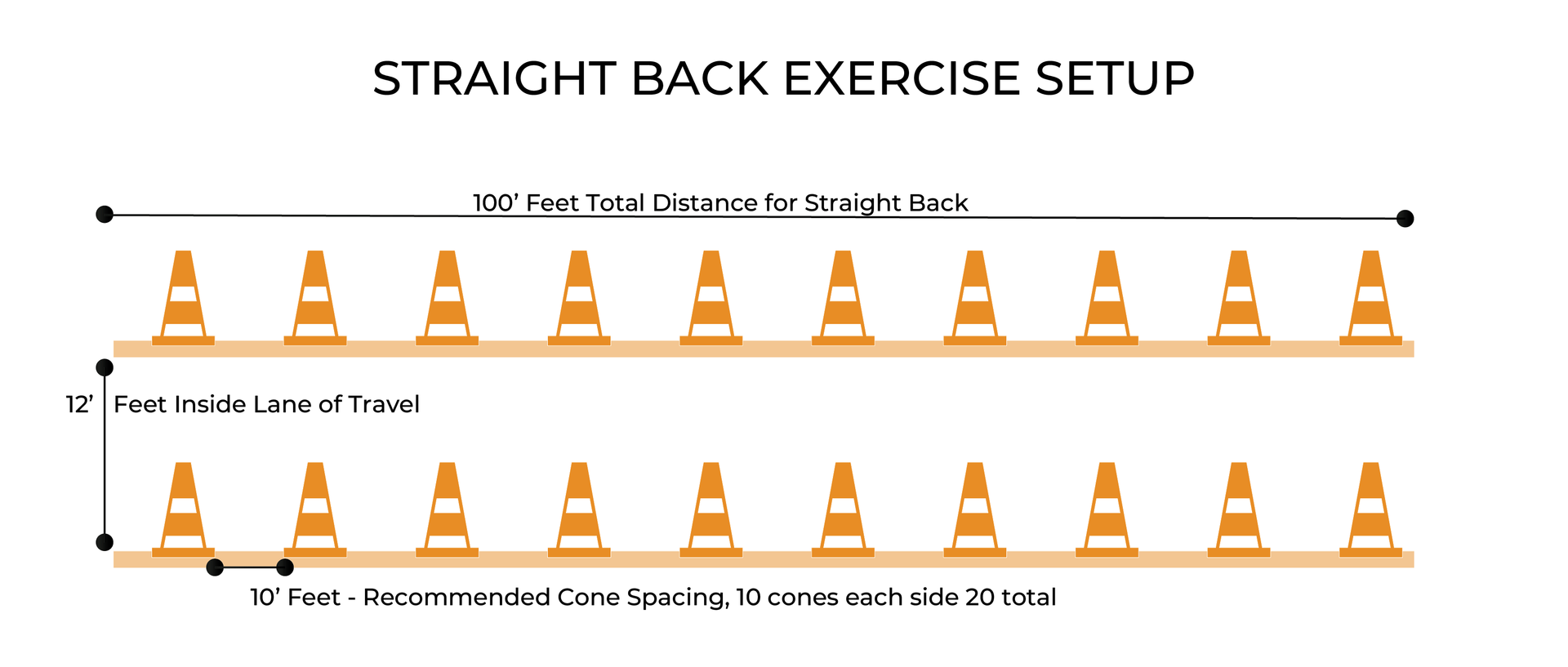
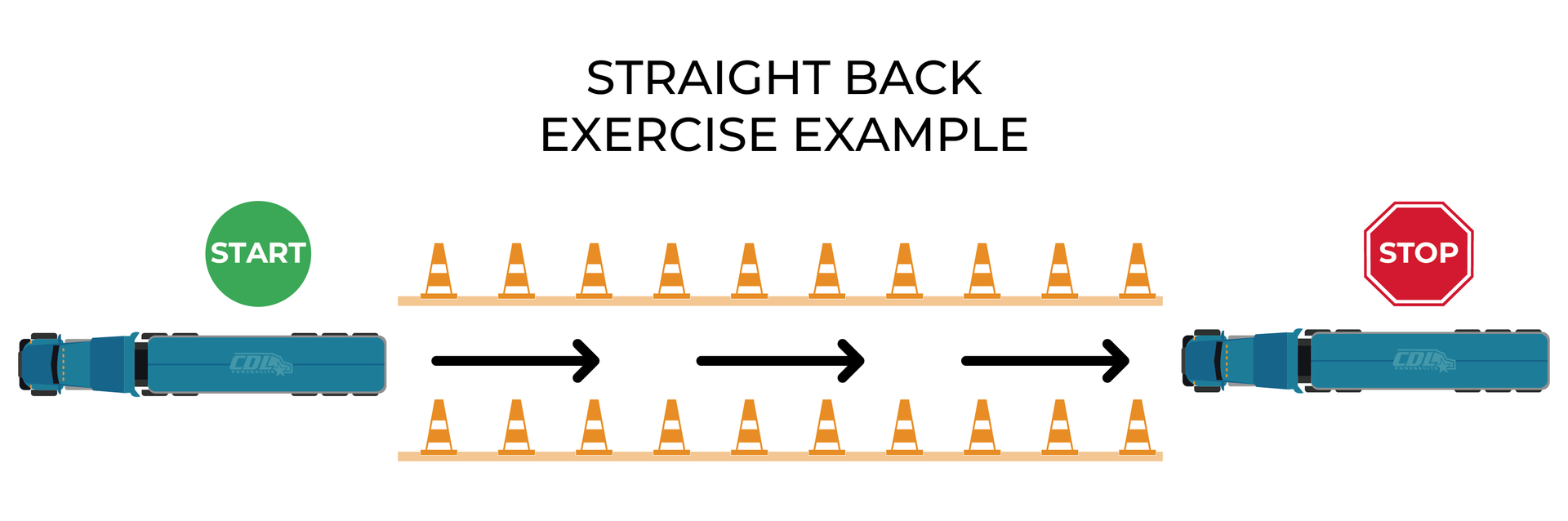
Starting a Straight Back Exercise:
To start 100 foot back, start with tractor and trailer outside of cone line. If Class B only start with vehicle outside of cone line.
Ending a Straight Back Exercise:
Once Tractor and Trailer are outside of cone line the trainee will set their air-brakes and honk the city horn. During a state test, this will notify the tester of your final position.
NOTE:
Make sure the trainee's front bumper is completely outside of the final cone.
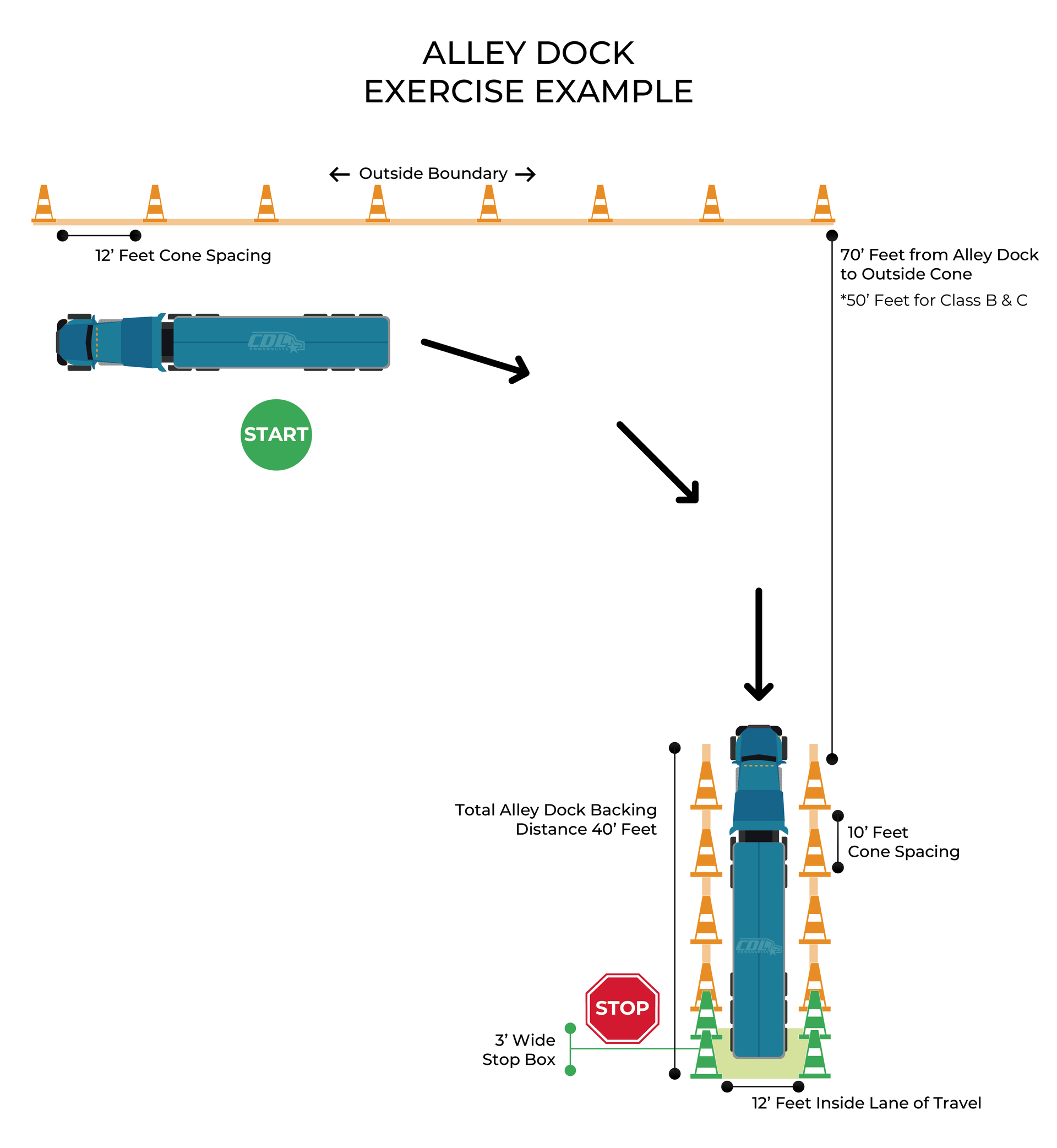
Starting an Alley Dock Backing Exercise:
Vehicle must start parallel with “Out of Boundary” Cones. Vehicle can pull forward as far as it needs or until there is an object blocking travel.
TIP:
Do not let the trainee park next to the outside cones when starting. They will not have enough room to turning into the 90.
Ending an Alley Dock Backing Exercise:
Vehicle must complete the exercise with the rear most part of the trailer or vehicle (Class B) inside the green cone area. Once the tractor and trailer are outside of cone line set air-brakes and have the trainee honk their city horn. This will be what notifies the tester of your their final position.
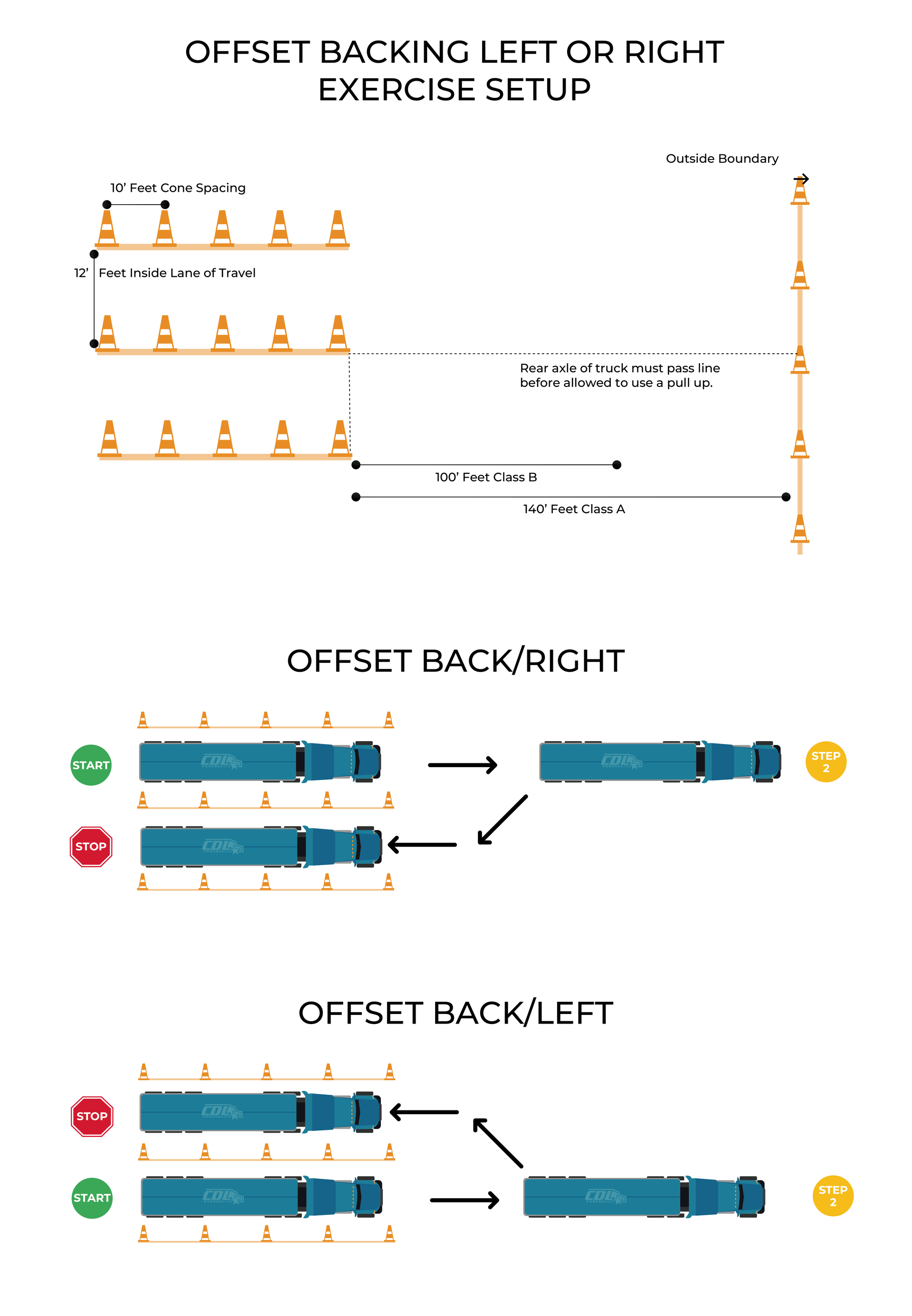
Starting an Offset Backing Exercise:
Vehicle will start the exercise pointed toward the outside boundary and the rear axel of the truck must pass the center line before they are allowed to use a pull up.
Ending an Offset Backing Exercise:
Vehicle will end in either the left or right lane with the front of the vehicle behind the first cone.
Note:
Measurements are the same of right & left lanes.
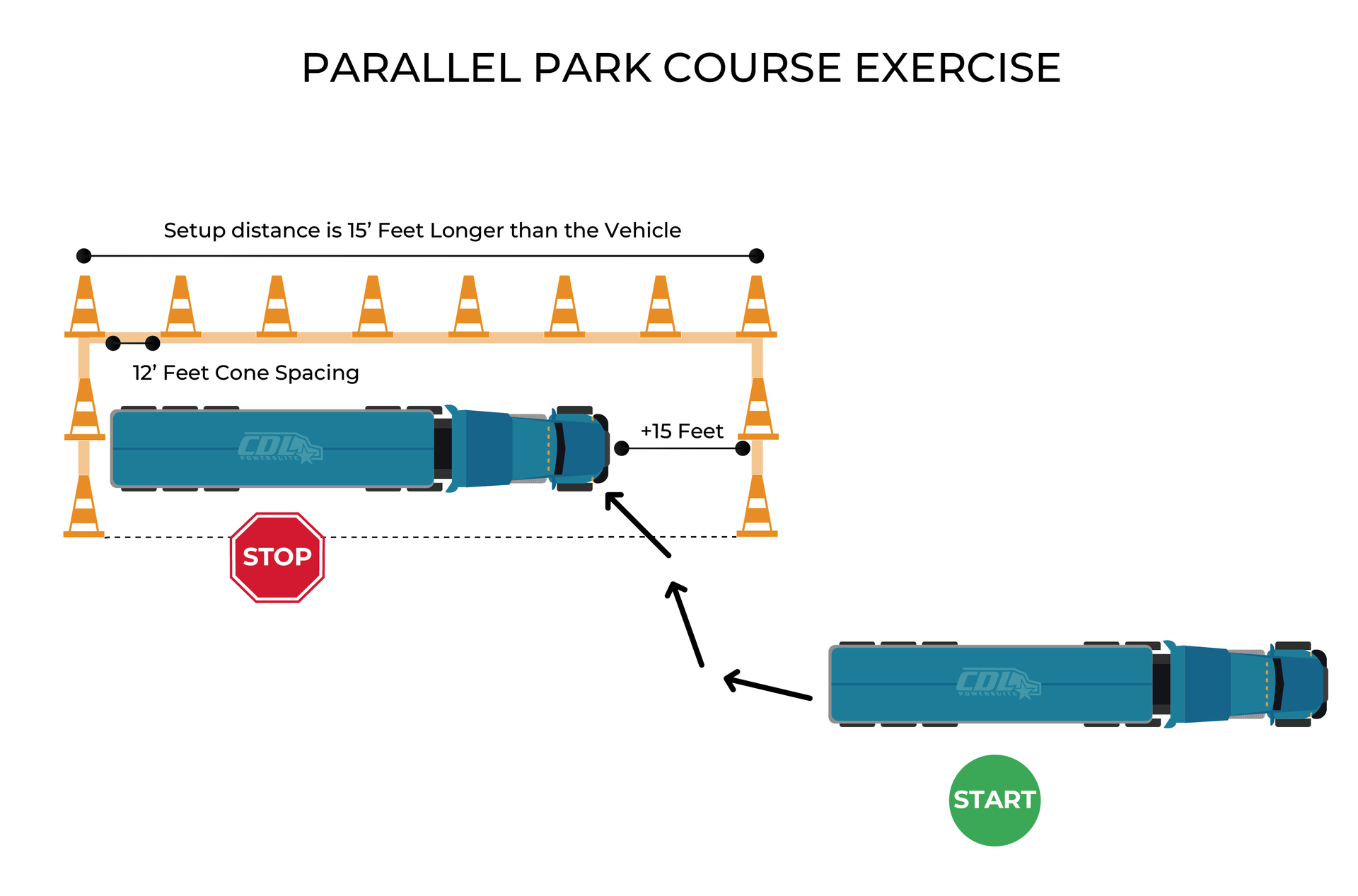
Starting a Parallel Park Exercise:
Vehicle will start in a position forward and parallel to the the longest distance of cones, which will be 15 feet longer than the vehicle being used.
Ending a Parallel Park Exercise:
Vehicle must complete the exercise with the whole vehicle (tractor and trailer) inside the cone area. Once tractor and trailer are completely inside the cone area the trainee will set their air-brakes and honk their city horn. This will notify the tester of their final position.