
Idaho CDL Trainer Requirements:
Learn the Idaho CDL trainer requirements that matter most for compliance.
What, Why, When, and How to Stay Compliant in the State of Idaho.
Whether you plan to become a CDL trainer in Idaho or already run a program and want cleaner compliance, this guide covers what applies. Idaho CDL training sits under two sets of rules: the federal Entry-Level Driver Training (ELDT) and Training Provider Registry (TPR) requirements, and, for proprietary schools with an Idaho presence, registration with the Idaho State Board of Education under IDAPA 08.01.11. A program can train well and still carry audit risk if it misses registration, TPR reporting, instructor files, or student records.
What does a CDL trainer in Idaho actually have to comply with?
At the federal level, Entry-Level Driver Training applies to anyone getting a Class A or Class B CDL for the first time, upgrading to a Class A or Class B CDL, or adding a passenger, school bus, or hazmat endorsement for the first time. To deliver it, a provider must be listed on FMCSA's Training Provider Registry, follow the curriculum in 49 CFR Part 380, use instructors who meet the definitions in 49 CFR 380.605 as 49 CFR 380.713 requires, and submit each completion through the TPR.
At the Idaho level, the
Idaho State Board of Education registers proprietary schools under
Idaho Code Title 33, Chapter 24 and
IDAPA 08.01.11, with the Office of the State Board of Education (OSBE) running the program.
Idaho Code §33-2401 defines a proprietary school as any person or entity with an Idaho presence that offers courses of study without granting degrees, and
OSBE's registration guide names commercial truck driving among them. Registration renews every year, and OSBE may verify a school's information by inspection or site visit. Federal rules link the two layers: under
49 CFR 380.703(a)(5), a TPR provider must be registered or authorized under the laws of each state where it trains in person.

Why Idaho CDL trainer compliance matters.
The training is only half the job. Federal rules require written theory assessments, documented behind-the-wheel proficiency, a TPR completion record by midnight of the second business day, and at least three years of record retention under 49 CFR Part 380. In Idaho, the Board can refuse to renew, suspend, or revoke a school's registration for violating Chapter 24 or IDAPA 08.01.11, for giving students false or misleading information, or for refusing a reasonable inspection or records request. Under Idaho Code §33-2409, an intentional violation is a misdemeanor and intentionally failing to register is a felony.
A registered school may describe itself only as "Registered with the Idaho State Board of Education," never as accredited or endorsed by the Board.
That makes trainer compliance a program-wide job, carried by the school's records, policies, and marketing as much as by its instructors.
When do Idaho specific rules apply to a CDL trainer?
Under Idaho Code §33-2403, every proprietary school that maintains a presence in Idaho must register annually, and IDAPA 08.01.11.101 counts any office or other physical location in Idaho, such as a classroom or training yard, a mailing or shipping center, or an Idaho address shown on a website or in marketing. Online instruction delivered by an out-of-state provider with no physical presence in Idaho falls outside that definition.
Two exemptions in §33-2403(4) matter most for CDL programs: an
employer training its own employees with no tuition charged to the student, and workshops of three days or less offered no more than four times a year.
OSBE's registration guide explains that the employer exemption covers people already on the payroll rather than prospective hires. Public colleges sit outside this layer:
Idaho Code §33-2402(1) exempts public postsecondary institutions supported primarily by Idaho state or local taxation from registration, and a proprietary school under §33-2401 is one that grants no degrees.
How do you become a CDL trainer in Idaho?
Idaho sets CDL instructor qualifications through the employing school's registration standards and the federal ELDT definitions.
At a registered proprietary school, IDAPA 08.01.11.301 requires each instructor to be appropriately qualified by any applicable trade board, with training and experience recorded and available to students. Every prospective student receives a complete list of instructors and their qualifications before enrolling. The school keeps enough instructors for stable courses and an effective instructor-to-student ratio, pays instructors without commissions, and follows a written procedure for evaluating them. OSBE's registration guide asks for each instructor's resume and any current state occupational license or certification.
Anyone who solicits students for the school, which can include owners, managers, and instructors, also carries a school-issued agent's certificate of identification under Idaho Code §33-2404, reissued every July 1. An agent who will have unsupervised contact with minors needs a criminal history check before the certificate is issued, and that check is valid for five years.
For federal ELDT, instructor standards come from
49 CFR 380.605, applied by
49 CFR 380.713. Theory and behind-the-wheel instructors hold a CDL of the same or higher class with the endorsements needed for the vehicle taught, and have either two years of experience driving a CMV in that class or endorsement or two years as a behind-the-wheel instructor. An instructor whose CDL was cancelled, suspended, or revoked for a disqualifying offense may not instruct for two years after reinstatement.
What does a Idaho CDL trainer have to teach?
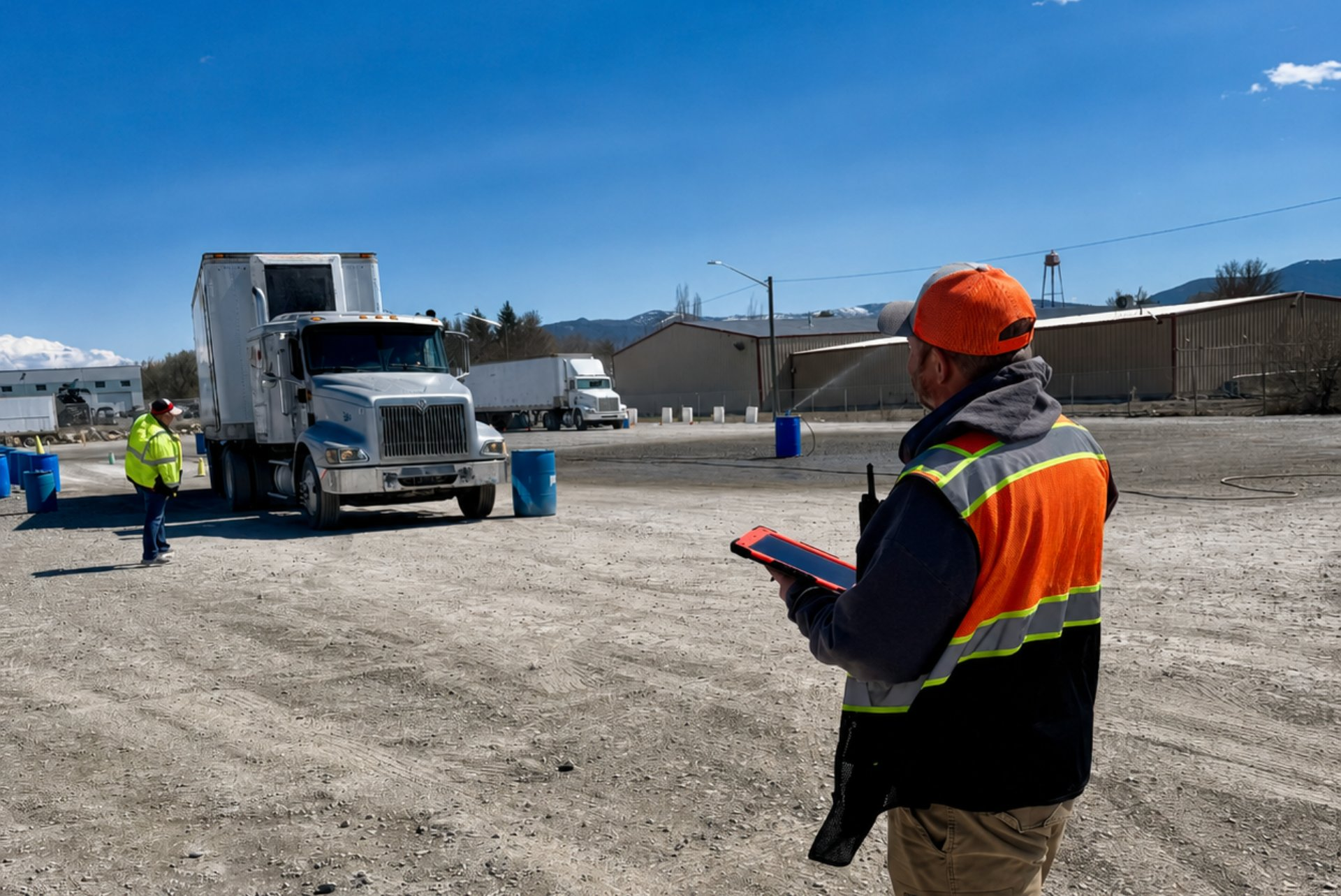
Federal ELDT sets the content. Providers follow the theory and behind-the-wheel curricula in Appendices A through E of 49 CFR Part 380 for Class A, Class B, passenger, school bus, and hazmat training, using qualified instructors, compliant facilities, and training vehicles in the same group and type the trainee will test in.
Idaho's registration standards shape how a school delivers that content. Under
IDAPA 08.01.11.301.02, a registered school defines each course's completion requirements, gives instructors a written description of every course, hands students a syllabus at the start of each course, and schedules courses often enough for students to finish on time. The school also attests that courses for occupations regulated by another agency meet that agency's licensure or certification standards, which for CDL training includes the federal ELDT curriculum.
How are Idaho trainees evaluated?
Federally, theory training ends in a written assessment, and the trainee needs an overall score of at least 80 percent under 49 CFR 380.715. Instructors evaluate and document proficiency in each required behind-the-wheel skill. ELDT is proficiency-based: federal rules set no minimum theory or behind-the-wheel hours, though the TPR completion record reports total BTW clock hours.
In Idaho, a registered school puts its own measures in writing. Before enrollment, every prospective student receives the completion requirements and an explanation of satisfactory progress, including the school's grading or assessment system. After training,
Idaho Transportation Department skills test examiners require a commercial learner's permit held for at least 14 days and completed ELDT, and the examiner verifies ELDT completion when scheduling the test.
What records does a Idaho CDL trainer or school need to keep?
Under 49 CFR 380.725, every TPR-listed provider keeps each BTW applicant's self-certification, a copy of the trainee's CLP or CDL, instructor qualification files with copies of instructors' CDLs and endorsements, theory and BTW lesson plans, and individual assessment records, for at least three years. Completion data, including total BTW clock hours, goes to the TPR by midnight of the second business day under 49 CFR 380.717.
Idaho adds its own files for registered schools. IDAPA 08.01.11.301.03 requires accurate, secure student records covering, at minimum, admissions information and the courses each student completed. When a student first pays, the school has the student sign the purchase statement set out in Idaho Code §33-2405, acknowledging that the school is registered and that the Board has not accredited or endorsed its courses, and keeps it in that student's file.
The school also keeps records of every agent's certificate of identification for five years under §33-2404(12), keeps required agent criminal history checks on file, records instructor qualifications, and keeps its financial records separate from any affiliated business using recognized accounting methods. Current course completion and job placement rates go to every prospective, new, and returning student.
What about school-level compliance in Idaho?
Registration runs on a July 1 to June 30 year. A new school can apply at any time, and IDAPA 08.01.11.101 advises allowing three to five months for review; a school may advertise and solicit students once it is registered. Renewals are due by the first business day of May, and a school whose renewal is not processed by July 1 must stop active operations until it is approved. Per OSBE's registration guide, the initial fee is $100; the annual fee is 0.5% of gross Idaho tuition revenue, with a $100 minimum and a $5,000 maximum.
Under Idaho Code §33-2406 and IDAPA 08.01.11.302, each school posts a surety bond at least equal to the tuition and fees of its currently enrolled students, based on projected revenue for the coming year and calculated on OSBE's worksheet. The bond stays in force all year, carries 120 days of extended coverage after a closure, and requires 120 days' notice before cancellation. Schools accredited by an accrediting organization the Board recognizes under IDAPA 08.01.11.100 are exempt from the bond.
A school that cannot fulfill its obligations to students must arrange a comparable teach-out or refund 100% of prepaid tuition. Changes to application information are reported within 30 days, and new locations and new courses each have their own OSBE form.
What are common Idaho CDL compliance mistakes?
- Treating TPR listing as Idaho authorization. Under 49 CFR 380.703(a)(5), TPR eligibility depends on state registration where training happens in person, and an Idaho school registers with the Board first.
- Advertising before registration is complete, or calling the school "approved," "accredited," or "endorsed" by the Board. The permitted wording is "Registered with the Idaho State Board of Education."
- Applying the employer exemption to recruits. It covers the employer's own employees, trained with no tuition charged to them.
- Missing the May renewal deadline, or letting the surety bond fall behind enrolled students' tuition.
- Waiting until test day to submit ELDT completions. Idaho examiners verify ELDT when the test is scheduled.
Final takeaway.
Training CDL drivers in Idaho means working inside two frameworks: federal ELDT and TPR rules for every provider, and, for proprietary schools with an Idaho presence, annual registration with the Idaho State Board of Education, a surety bond, and documented student, agent, and instructor files. The programs that stay audit-ready build those records as training happens.
Compliance disclaimer.
This page summarizes Idaho Code Title 33, Chapter 24, IDAPA 08.01.11, Office of the State Board of Education guidance, Idaho Transportation Department skills test materials, and FMCSA ELDT and Training Provider Registry rules for general information, current as of October 2026. Applicability varies by training model and by whether a program is school-based, employer-based, or publicly run, so Idaho providers should verify current requirements with OSBE and FMCSA before relying on this summary.