CDL Tuition Assistance

Jason Boudreau • October 27, 2025

One Application. 55 Lenders. Endless Opportunity.
Affordable CDL Training Starts Here

For many aspiring drivers, earning a Commercial Driver’s License (CDL) is the key to a stable, well-paying career in the transportation industry. Yet one of the biggest challenges remains affording CDL school tuition.


At CDL PowerSuite, we’ve seen firsthand that funding is often the number one barrier keeping motivated students from pursuing training. Many potential students simply can’t pay the full cost upfront — even though a CDL can unlock career growth and financial stability for years to come.


That’s why CDL PowerSuite has launched CDL Tuition Assistance, powered by our partnership with MoneyLion — a trusted online lending platform connecting students to 55 lenders through one easy application.


Making CDL Training More Accessible

The goal of CDL Tuition Assistance is simple: to make CDL school financially accessible for everyone.


By connecting students to multiple lenders through a single online application, this program provides flexible and transparent financing options to cover CDL training and related expenses.


Whether a student is just starting their journey or returning to upgrade their credentials, CDL Tuition Assistance helps remove financial barriers and opens the door to new opportunities.


How CDL Tuition Assistance Works

Our process is designed to make funding simple for students and efficient for training providers:

  1. Complete One Application
    Students fill out a quick, online form that connects them to multiple trusted lenders.

  2. Get Matched With 55 Lenders
    Through MoneyLion’s network, applicants receive a variety of lending options with competitive rates and repayment terms.

  3. Fast Approvals, Flexible Funding
    Most applicants receive funding options quickly — helping them start CDL training sooner.

Streamlined Enrollment for Providers
Training providers can enroll more students, faster, while supporting those who may not have upfront funds


Why CDL Tuition Assistance Matters

The U.S. continues to face a nationwide truck driver shortage, with thousands of open positions across the logistics and transportation industries. By making CDL training more affordable, we can help more qualified drivers enter the workforce and strengthen the industry’s future.

For CDL schools and training providers, this initiative means:

  • Easier access to CDL training funding for students

  • Increased enrollment and completion rates

  • Reduced administrative burden around tuition collection

  • A stronger reputation as a student-focused organization

This isn’t just a financing tool — it’s a way to help transform lives and careers through accessible CDL education.


Built to Support CDL Training Providers

CDL PowerSuite’s mission is to empower training providers with the technology and tools they need to operate efficiently and serve their students better.


From digital compliance management to student communication and performance tracking, our platform is built to simplify every part of your operation.


Adding CDL Tuition Assistance to your admissions toolkit helps you attract more students, boost retention, and remove one of the most significant obstacles to enrollment: affordable CDL school financing.


Start Empowering Your Students Today

If you’re ready to help more students pursue their CDL career dreams, discover how CDL Tuition Assistance can make a difference.


Download the Student Funding Guide (Free)

Get Your Free Tuition Assistance Guide
Tuition Assistance: Semi-trucks, woman on phone. Blue text box,
August 17, 2026
Every certification your school submits to the Training Provider Registry rests on one thing: the instructor who signed off was qualified to do it. That makes instructor qualifications the single highest-stakes file in your building. When a student's record gets questioned, the school defends one certification. When an instructor's qualifications get questioned, every student that instructor ever signed off is in question at the same time. One gap, multiplied by hundreds of graduates. That is why instructor files deserve more attention than they usually get, and why "we know our people are qualified" is a sentence worth retiring. Knowing it and proving it are two different jobs. The second one is the one that counts. What qualified actually means The federal requirements come down to a few things. A behind-the-wheel instructor needs to hold a CDL of the same or higher class, with the endorsements needed for the vehicle they are teaching in, plus at least two years of experience driving that class of vehicle or two years of experience as an instructor. A clean licensing history matters too. An instructor whose CDL has been suspended, revoked, or cancelled in the recent past can be disqualified from teaching, even if their license looks valid today. Then the states add their own layer. Some require instructor licenses, background checks, or their own experience documentation on top of the federal floor. The federal rule is the minimum, and your state decides how much higher the bar sits. A school operating in more than one state can have different qualification requirements for instructors doing the same job. Qualified on paper, provable on demand Here is where schools get caught. The instructor genuinely is qualified. Twenty years behind the wheel, endorsements for everything, sharp as they come. But the file holds a photocopy of a CDL from three renewals ago and nothing else. When someone asks the school to prove the qualification, the proof is a phone call to the instructor asking them to bring their license in. A complete instructor file answers the question before anyone asks it. A current copy of the CDL with the right class and endorsements. Documentation of the experience that qualifies them, whether that is driving history or instructional history. The MVR on file and reviewed. State instructor credentials where they apply. Every requirement, matched to a document, sitting in one place. When an auditor asks, the answer takes minutes instead of a scramble. 
August 10, 2026
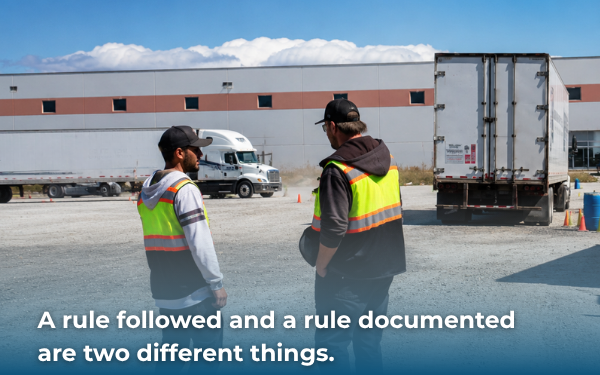
Every school knows the rule: the person who trains a student and the person who tests them have to be two different people. It is one of the oldest lines in third-party testing, and everyone in this industry can recite it. Knowing it happened is different from showing it happened Most schools keep the trainer and examiner separate every single time. The owner would swear to it, and they would be telling the truth. The problem is that swearing to it is all they can do. When the proof of separation lives in people's memory of who was working that day, the school has compliance that evaporates the moment memory fades or staff move on. To an auditor, a rule followed and a rule documented are two different things, and only one of them counts. The test of your documentation is simple. Pull a student file from eighteen months ago. Could a stranger look at that file and identify who trained the student and who examined them, on their own, in under a minute? If the answer requires someone to explain, the record is incomplete. The separation should be visible on the page itself. What the paper trail actually requires Two layers of documentation make the separation provable. The first is the training history. Every training event should name the instructor who delivered it. The person, specifically. A student's file should read like a roster of everyone who worked with them: which instructor ran their range sessions, which one sat with them on the road, on which dates. The complete list of who touched the student's training is the foundation, because proving the examiner was independent starts with a record of everyone who trained the student. The second is the testing record. The skills test should name the examiner just as clearly, tied to the date and the result. Put the two layers side by side and the separation proves itself. The examiner's name is absent from the training history, and the case is closed. Zero explanation, zero reconstruction, zero calls to the scheduler to vouch for who did what.