
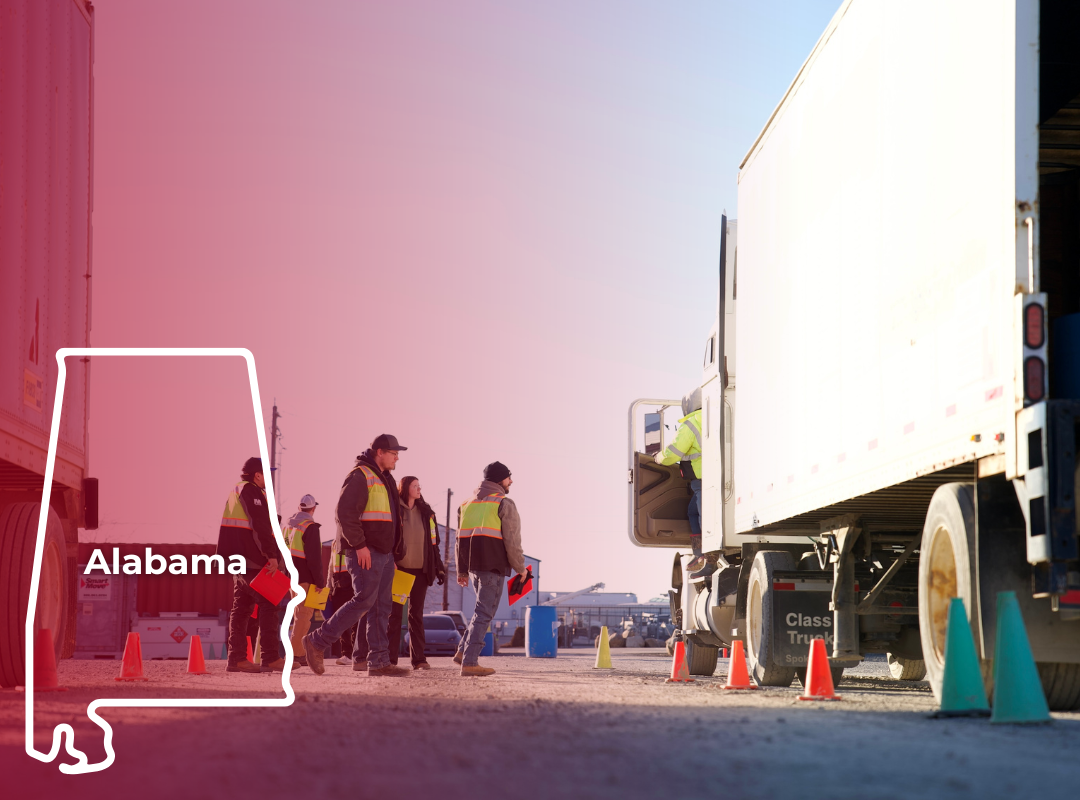
Alabama CDL Trainer Requirements:
Learn the Alabama CDL trainer requirements that matter most for compliance.
What, Why, When, and How to Stay Compliant in the State of Alabama.
Whether you plan to become a CDL trainer in Alabama or already run a program and want cleaner compliance, this guide covers what applies. Alabama CDL training sits under two sets of rules: the federal Entry-Level Driver Training (ELDT) and Training Provider Registry (TPR) requirements, and, for private schools that are not exempt, a Private School License from the Alabama Community College System (ACCS) under Ala. Code Title 16, Chapter 46. A program can train well and still carry audit risk if it misses licensure, TPR reporting, instructor files, or student records.
What does a CDL trainer in Alabama actually have to comply with?
At the federal level, Entry-Level Driver Training applies to anyone getting a Class A or Class B CDL for the first time, upgrading to a Class A or Class B CDL, or adding a passenger, school bus, or hazmat endorsement for the first time. To deliver it, a provider must be listed on FMCSA’s Training Provider Registry, follow the curriculum in 49 CFR Part 380, use instructors who meet the definitions in 49 CFR 380.605 as 49 CFR 380.713 requires, and submit each completion through the TPR.
At the Alabama level, the
ACCS Private School Licensure Division licenses private postsecondary schools under the
Alabama Private School License Law and ACCS’s
Guidelines for Private School License. Under
Ala. Code §16-46-5(a), a private school may not operate in Alabama without a license, whether or not it enrolls Alabama students or has a physical presence in the state. Statute references to the former Department of Postsecondary Education now mean ACCS under
§16-60-110.1. Federal rules link the two layers: under
49 CFR 380.703(a)(5), a TPR provider must be licensed, certified, registered, or authorized under the laws of each state where it trains in person.
Why Alabama CDL trainer compliance matters.
Federal rules require written theory assessments, documented behind-the-wheel proficiency, a TPR completion record by midnight of the second business day, and at least three years of record retention under 49 CFR Part 380. In Alabama, operating a non-exempt private school without a license is a misdemeanor under Ala. Code §16-46-10, punishable by a fine of up to $500, up to six months in jail, or both, with each day a separate offense, and ACCS may put a license on probation, suspend it, or revoke it for fraud, deception, or misrepresentation.
A licensed school may say only that it is licensed by the state, never that ACCS endorses it, and no school may advertise, including on a website, before its license issues.
That makes trainer compliance a program-wide job, carried by the school’s records, policies, and marketing as much as by its instructors.
When do Alabama specific rules apply to a CDL trainer?
Under Ala. Code §16-46-5(a), every private school that §16-46-3 does not exempt needs a Private School License before it operates in the state, whether or not it enrolls Alabama students or has a physical presence there. That covers CDL programs run by for-profit and nonprofit private entities, and ACCS licenses courses offered through distance learning as well as on a resident campus.
Exemptions come from
Ala. Code §16-46-3(b). Two matter most for CDL programs: courses
conducted by employers exclusively for their employees, and schools
principally operated and supported by the State of Alabama or its political subdivisions, such as Alabama’s public community and technical colleges. ACCS’s
exemptions page documents the employer exemption with a policy limiting enrollment to currently employed persons, and asks any school claiming an exemption to file for a
Certificate of Exemption. Confirm with ACCS whether an employer’s in-house CDL program needs to file one.
How do you become a CDL trainer in Alabama?
Alabama sets CDL instructor qualifications through the employing school’s ACCS license and the federal ELDT definitions.
At a licensed private school, Section IV.F of ACCS’s Guidelines for Private School License requires instructors to have the education and experience to meet each course’s objectives. A high school diploma or equivalent plus appropriate work experience is acceptable for occupational instruction, occupations that require licensure or certification must be taught by people holding the appropriate credentials, and an instructor teaches only in the specialty for which they are credentialed or licensed. The school’s catalog lists each instructor’s name and credentials, and the school reports faculty changes to ACCS within 30 days.
Instructors who also sell courses or recruit students away from the school’s licensed facilities need an agent permit under Ala. Code §16-46-6. Per the ACCS fee schedule, the permit costs $100 and $50 to renew every two years, the school covers each agent with a $2,500 blanket bond, and the agent carries the permit card while recruiting.
For federal ELDT, instructor standards come from
49 CFR 380.605, applied by
49 CFR 380.713. Theory and behind-the-wheel instructors hold a CDL of the same or higher class with the endorsements needed for the vehicle taught, and have either two years of experience driving a CMV in that class or endorsement or two years as a behind-the-wheel instructor. An instructor whose CDL was canceled, suspended, or revoked for a disqualifying offense may not instruct for two years after reinstatement.
What does a Alabama CDL trainer have to teach?
Federal ELDT sets the core content. Providers follow the theory and behind-the-wheel curricula in Appendices A through E of 49 CFR Part 380 for Class A, Class B, passenger, school bus, and hazmat training, using qualified instructors, compliant facilities, and training vehicles in the same group and type the trainee will test in.
Alabama law adds
human trafficking training. Under
Act 2019-417, codified at Ala. Code §16-60-117.1, trade schools and junior colleges that teach commercial motor vehicle operation include industry-specific training on recognizing, preventing, and reporting human trafficking, updated each year under the ACCS Board of Trustees.
Private driver training schools must use best efforts to include the same training. A licensed private school offers only ACCS-approved courses.
How are Alabama trainees evaluated?
Federally, theory training ends in a written assessment, and the trainee needs an overall score of at least 80 percent under 49 CFR 380.715. Instructors evaluate and document proficiency in each required behind-the-wheel skill. ELDT is proficiency-based: federal rules set no minimum theory or behind-the-wheel hours, though the TPR completion record reports total BTW clock hours.
In Alabama, a licensed school puts its completion requirements in each student’s enrollment agreement, along with any state, federal, or licensing requirements for programs that lead to licensure, under Section IV.K of the ACCS
Guidelines. After training, the
Alabama Law Enforcement Agency (ALEA) Driver License Division requires a commercial learner’s permit held at least 14 days before CDL testing and ELDT for anyone getting a CDL for the first time. Since July 1, 2025, ALEA has given the
modernized CDL skills test, with revised vehicle inspection and basic control skills sections.
What records does a Alabama CDL trainer or school need to keep?
Under 49 CFR 380.725, every TPR-listed provider keeps each BTW applicant’s self-certification, a copy of the trainee’s CLP or CDL, instructor qualification files with copies of instructors’ CDLs and endorsements, theory and BTW lesson plans, and individual assessment records, for at least three years. Completion data, including total BTW clock hours, goes to the TPR by midnight of the second business day under 49 CFR 380.717.
Alabama adds its own files for licensed schools. Under Ala. Code §16-46-5(i)(3), a school keeps adequate records of attendance and student progress and furnishes them, at the student’s request, to prospective employers and other interested parties. ACCS’s Guidelines require essential records, including permanent records, applications, enrollment agreements, and completion documents, to be kept current and accurate at each location or instructional site and protected from loss or unauthorized access. Each student receives a signed copy of the enrollment agreement with all attachments.
If a school closes, §16-46-3(f) sends its student academic, attendance, and financial aid records to a designated repository, and the Guidelines require a closure plan stating where records will be stored and how the public can reach them.
What about school-level compliance in Alabama?
An Alabama Private School License is valid for two years and is displayed publicly where the school operates. ACCS sends a renewal notice at least 60 days before expiration, renewal materials are due at least 30 days before it, and unsubmitted renewals carry a $75-per-day late fee. Per the October 1, 2024 fee schedule, a non-degree school pays a $25 application fee plus a license fee of one-half of one percent of annual gross income, with a $1,500 minimum and $17,500 maximum; each new program costs $150, plus $300 if a site visit is required.
Under
Ala. Code §16-46-5(e) and the
Guidelines, a non-degree school posts a continuous
$20,000 performance surety bond on ACCS Form PS-2 that covers all of its locations, and a canceled or lapsed bond leads to suspension and then revocation. Each branch is separately licensed and keeps its own records, and ACCS visits Alabama-based schools with or without notice. Changes in accreditation, governing board, faculty, or curriculum are reported within 30 days, and an ownership change needs 30 days’ advance notice because a license does not transfer. Refunds follow the Guidelines: a full refund for cancellation within 72 hours of enrolling, pro rata after classes begin, paid within 30 days.
What are common Alabama CDL compliance mistakes?
- Treating TPR listing as Alabama authorization. Under 49 CFR 380.703(a)(5), a private Alabama school gets its state authorization from its ACCS license.
- Advertising, including on a website, before the license issues.
- Applying the employer exemption to recruits. It covers courses employers conduct exclusively for their employees.
- Letting the $20,000 surety bond lapse, or filing renewal materials late.
- Leaving human trafficking training out of the CDL curriculum.
Final takeaway.
Training CDL drivers in Alabama means working inside two frameworks: federal ELDT and TPR rules for every provider, and, for private schools that are not exempt, a two-year ACCS Private School License, a $20,000 surety bond, ACCS-approved courses, and documented student and instructor files. The programs that stay audit-ready build those records as training happens.
Compliance disclaimer.
This page summarizes Ala. Code Title 16, Chapter 46, Ala. Code §16-60-117.1, Alabama Community College System (ACCS) private school licensure guidance, ALEA CDL guidance, and FMCSA ELDT and TPR rules for general information, current as of November 2026. Requirements vary by training model, so Alabama providers should verify current rules with ACCS, ALEA, and FMCSA before relying on this summary.