
Teaching Space Management
Jason Boudreau • April 2, 2025
Ensuring that new commercial drivers understand the importance of space management is crucial for their safety—and the safety of everyone on the road. As an instructor, your role is to not only teach the concepts but also to instill the habits and decision-making skills that will help trainees maintain safe space in every driving condition.
This guide is based on the Washington State CDL Manual and aligned with the ELDT curriculum, specifically
Unit 1.2.5 – Space Management.
Why Space Management Matters
Space is a commercial driver's best defense. Large vehicles take longer to stop, accelerate more slowly, and require more room to maneuver. When things go wrong, having space allows drivers to take evasive action and avoid collisions. Your trainees need to learn that managing space is not just a defensive driving tactic—it’s a professional standard.
Space Ahead
Most collisions involving large vehicles occur in front of the vehicle. Reinforce the following:
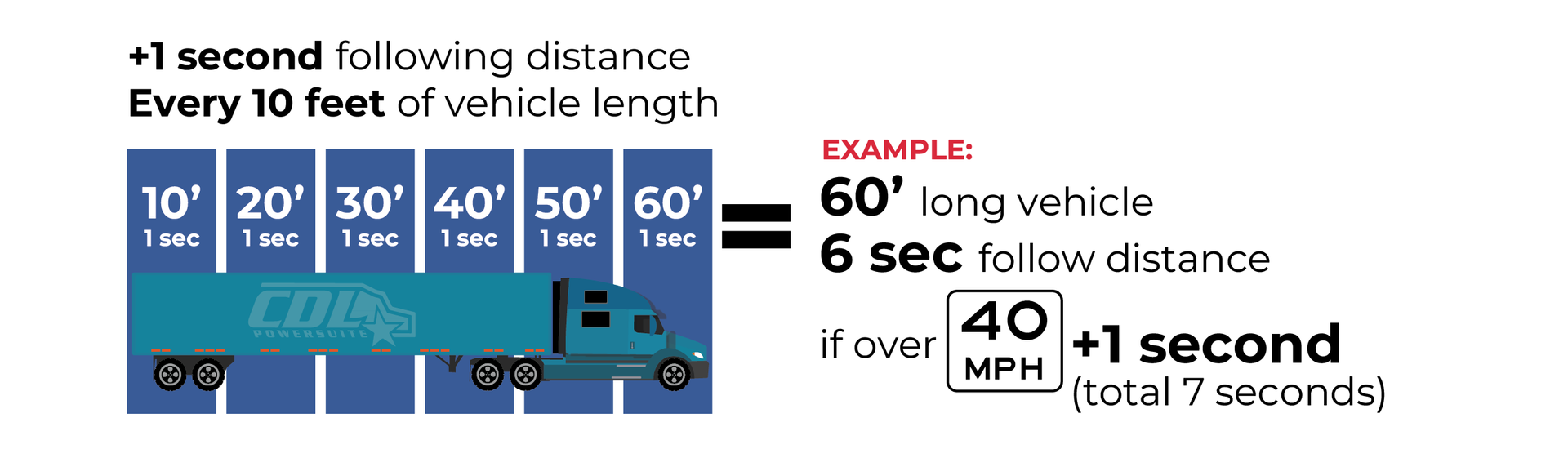
- Following Distance Rule: One second per 10 feet of vehicle length under 40 MPH. Add one second if traveling over 40 MPH.
Example: A 60-foot truck at 50 MPH = 7 seconds. - Hazard Perception:
Emphasize the importance of anticipating sudden stops and maintaining buffer zones—especially when following smaller, faster-stopping vehicles.
Space Behind
Drivers can't control who follows them, but they can manage how to respond.
- Stay to the Right: Encourage staying in the right lane to allow faster vehicles to pass. Some states have requirements surrounding this.
- For example: In Washington State, commercial vehicles (over 10,000 pounds) are generally required to stay in the right lane on limited-access roadways with three or more lanes, unless passing, turning left, or exiting, and are prohibited from using the far-left lane.
- Dealing with Tailgaters: Instruct drivers to:
- Avoid sudden speed or direction changes.
- Increase following distance from the vehicle ahead.
- Refrain from flashing brake lights or speeding up.
Space to the Sides
Wider vehicles demand awareness of lateral clearance.
- Lane Centering:
Teach consistent lane tracking and the importance of mirror use.
- Avoiding Others:
Stress the dangers of traveling beside other vehicles too long—especially in high winds or narrow lanes.
Space Overhead
Many trainees overlook the vertical space needed by heavy vehicles.
- Teach drivers to:
- Know their vehicle’s height, loaded and unloaded.
- Approach bridges and overpasses with caution.
- Be mindful of tree limbs, power lines, and garage doors, especially when backing.
Space Below
Underride hazards are easy to miss but dangerous.
- Point out common risk zones:
railroad tracks, dips in yards, and drainage channels.
- Train drivers to assess clearance before crossing or parking in uneven terrain.
Space for Turns
Wide turns are one of the biggest challenges new drivers face.
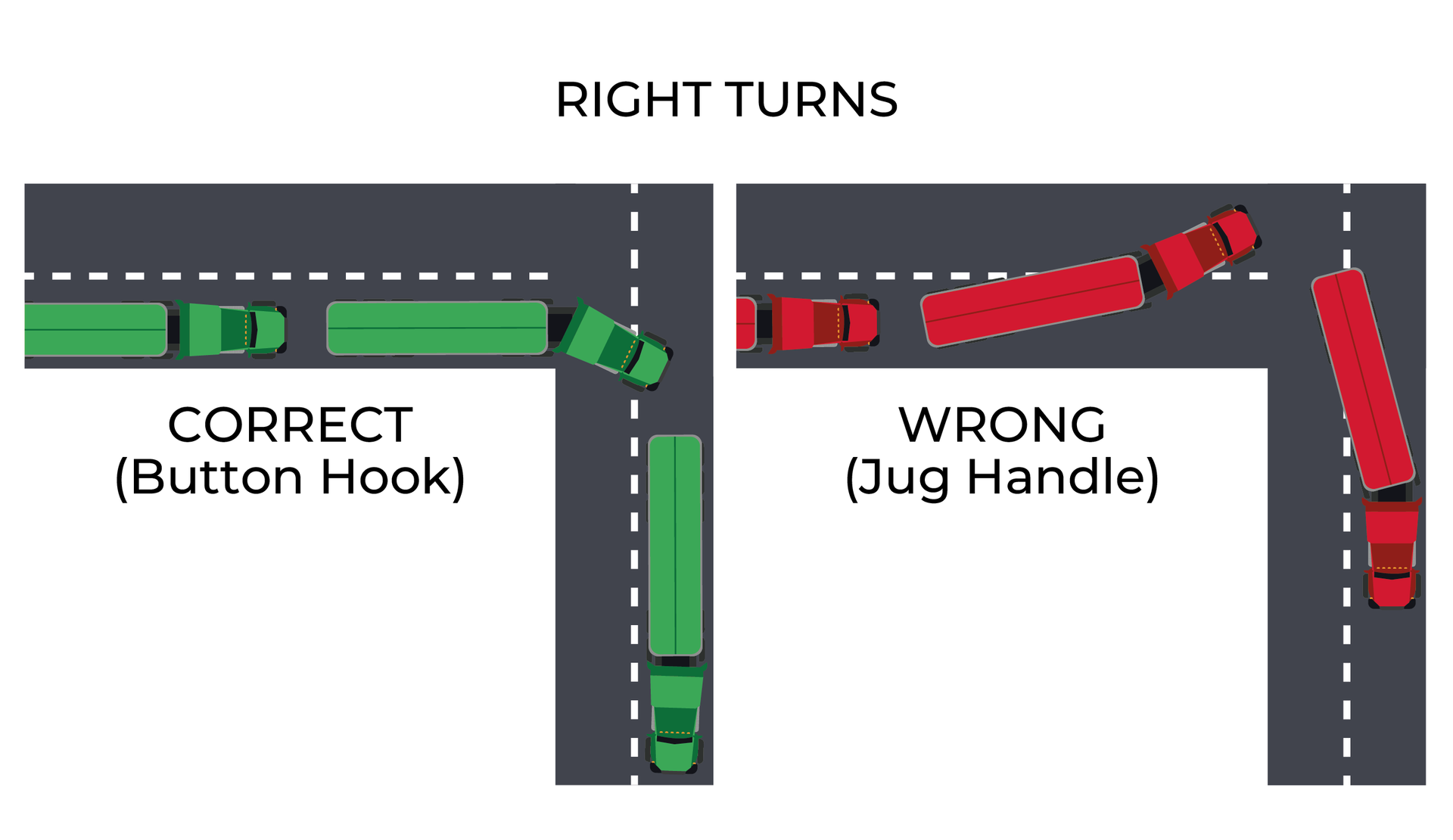
- Right Turns: Emphasize Button-Hook technique, not swinging wide left at the start (Jug Handle). This prevents other vehicles from passing on the right and entering into an oncoming lane of traffic without other drivers being aware you are doing so. With the Button Hook technique drivers can proceed when they see the opposing lane of traffic is clear.
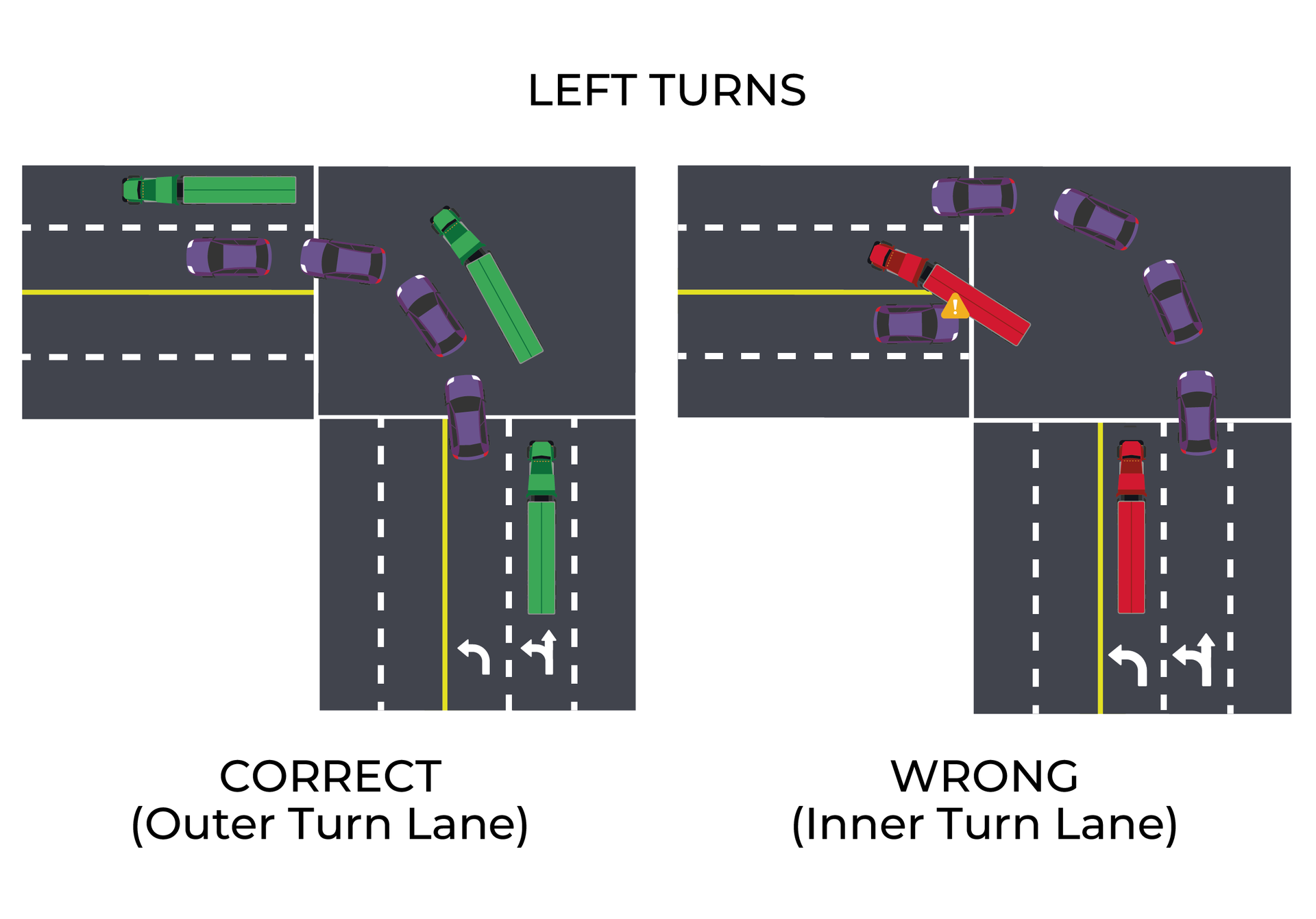
- Left Turns: Wait until the center of the intersection before initiating the turn. Avoid inside turn lanes if two are available—take the outer lane for better visibility and space. This also can avoid a potential collision with vehicles waiting in the opposing lane of traffic.
Space Needed to Cross or Enter Traffic
Instructors should highlight:
- Gap Judgment:
Due to slow acceleration, heavy vehicles need significantly larger gaps than passenger cars.
- Load Impact:
Teach that a fully loaded truck will take longer to cross traffic—students should plan accordingly.
- Clear Crossings: Never begin crossing unless the driver can clear the entire road before traffic arrives.
Instructional Best Practices
- Simulate Scenarios:
Use real-life examples and “what would you do?” drills to reinforce decision-making.
- Mirror and Reference Point Training:
Show how to use mirrors and fixed points to judge space during turns and lane placement.
- Hands-On Practice:
Provide ample driving time in varied environments—urban, highway, narrow roads, and inclines.
Final Thoughts
Teaching space management isn’t about memorizing rules—it’s about shaping a driver’s awareness and anticipation. Reinforce the principle that managing space is a proactive responsibility, not just a reaction to threats.
As an instructor, you are equipping future CDL drivers with one of the most important tools for their career: the ability to create and maintain safe space at all times.