
Running an In-House School District CDL Training Program: The Complete FMCSA Compliance Guide
The moment your district trains its own bus drivers, you become a federally regulated training provider. Here's everything you're responsible for — and how to build a program that survives an audit.
What makes your district a training provider
If a school district anywhere in the United States trains even one new bus driver in-house — meaning the district itself, rather than a third-party CDL school, delivers the required ELDT theory and behind-the-wheel instruction — that district is, by federal definition, a Training Provider. This is a legal status, not a label of convenience. It carries the same obligations as a commercial CDL school operating across multiple states.
The trigger is the Entry-Level Driver Training rule under 49 CFR Part 380, which took effect February 7, 2022. The rule applies to any driver obtaining a Class A or Class B CDL for the first time, any driver upgrading from Class B to Class A, and any driver seeking a first-time Passenger (P), School Bus (S), or Hazardous Materials (H) endorsement. The training itself can only be delivered by an entity listed on the FMCSA Training Provider Registry — and that includes school districts.
This guide walks through the six compliance pillars every in-house program must meet, plus the supporting topics that determine whether your program is audit-ready or audit-vulnerable: state-layered requirements, the audit process itself, the common failure modes, and what a sustainable long-term program actually looks like.
Before you read further
The standard does not bend for the size of your program. A district training one driver per year is held to the same compliance bar as a multi-state commercial CDL school training thousands. The size of your liability scales differently than the size of your obligation.
section One
TPR Registration
49 CFR § 380.703 · 49 CFR § 380.717
The Training Provider Registry is the FMCSA's authoritative list of every entity legally permitted to deliver ELDT in the United States. If your district is not on it, your training is not valid for license issuance — full stop. A trainee who completes "training" from a non-registered provider cannot sit for the CDL skills test.
What registration actually requires
Registration is a self-certification process. The district submits a registration through the FMCSA's online portal and attests, under penalty of perjury, that it meets every applicable requirement. The submission must include:
- Legal name, USDOT number (if applicable), and primary business address
- Every physical location where training will be delivered (classroom, range, and on-road)
- The classes and endorsements covered (Class B, P, S, etc.)
- A list of every theory and BTW instructor, with documentation of their qualifications
- Every CMV used for BTW training, including VIN, license plate, and proof of insurance
- Curriculum identification (whether internally developed or vendor-supplied)
- State-level authorization where applicable
Keeping the registration current
Registration is not "set it and forget it." TPR registration is not a one-time task. FMCSA requires providers to update their registration every two years, report key information changes within 30 days, and maintain records proving continued ELDT compliance. Inaccurate information or unresolved compliance issues can result in removal from the Training Provider Registry.
Practical tip
The most common compliance gap at this pillar is staffing turnover. An instructor leaves, a new one is hired, and the district forgets to update the TPR. If that new instructor signs off on a trainee before the registry is updated, every certification they submit is potentially invalid.
section two
Curriculum Delivery
49 CFR § 380.609 · Appendices A–E
FMCSA specifies, by appendix, the curriculum units every ELDT program must deliver. These are not suggested topics. They are mandatory units, and your program must cover each one in the appropriate appendix — verbatim in scope, even if you choose your own teaching methods within that scope.
The Class B theory curriculum (Appendix B)
The Class B theory curriculum is organized into five domains and over 30 individual units, including:
- Basic Operation: orientation, controls/instruments, vehicle inspections, basic vehicle control, shifting/transmissions, backing and docking, coupling/uncoupling (where applicable)
- Safe Operating Procedures: visual search, communication, distracted driving, speed management, space management, night driving, extreme conditions
- Advanced Operating Practices: hazard perception, skid avoidance and recovery, railroad-highway grade crossings
- Vehicle Systems & Reporting Malfunctions: identifying and reporting malfunctions, basic vehicle systems knowledge
- Non-driving Activities:
- handling cargo, environmental compliance issues, post-crash procedures, external communications, whistleblower protections, Hours of Service, fatigue and wellness, hazmat awareness, trip planning
The school bus theory curriculum (Appendix E)
The School Bus (S) endorsement adds its own dedicated theory units that no other CDL category requires. These are the units that distinguish a school bus driver's preparation from a general CDL holder's:
- Danger zones and use of mirrors — the 12-foot zone around the bus and the mirror system used to monitor it
- Loading and unloading — approach, warning lights, student management at the stop, departure procedures
- Emergency exit and evacuation — mandatory drills, accountability protocols
- Railroad-highway grade crossings — the school-bus-specific complete-stop and scan procedure
- Student management and anti-bullying — behavioral expectations, mandatory reporter responsibilities
- Special needs considerations — IDEA-related rights, special equipment, communication with aides
The passenger theory curriculum (Appendix D)
The Passenger (P) endorsement curriculum covers passenger safety, pre- and post-trip inspections specific to passenger vehicles, after-an-accident procedures, and other passenger-vehicle-specific knowledge. It is shorter than the school bus appendix but still mandatory.
The behind-the-wheel curriculum (Appendices B & C)
FMCSA divides BTW training into two distinct components:
range (off-public-road, controlled environment) and
public road (live traffic). Both are mandatory for Class A and Class B CDL training. Each has its own list of required maneuvers and skills.
Audit note
FMCSA does not require minimum hours for theory or BTW training. It requires demonstrated proficiency. But several states have layered minimum-hour requirements on top of the federal floor — a topic covered in detail in the State-Layered Requirements section below.
section three
Instructor Qualifications
49 CFR § 380.605
The single most common audit finding against in-house training programs is undocumented or under-qualified instructors. If your district has been letting a senior driver "show the new hire the ropes," and that informal mentor isn't on the TPR with documented qualifications, every record they touch becomes a compliance liability.
Theory instructor requirements
A theory instructor — anyone delivering classroom-based or self-paced knowledge instruction — must:
- Hold a CDL of the same or higher class as the training being delivered, with every endorsement necessary to operate the type of CMV in question. For school bus theory, this means holding both the P and S endorsements, in addition to the Class B (or higher) CDL.
- Have at least two years of experience driving a CMV requiring that CDL class and those endorsements, or at least two years of experience as a BTW instructor for CMVs.
- Meet any additional state-level certification or training requirements that apply.
BTW instructor requirements
A BTW instructor — anyone delivering range or public-road training — must meet the same baseline qualifications as a theory instructor, with two additional considerations:
- If an instructor's CDL has previously been cancelled, suspended, or revoked for any disqualifying offense listed in § 383.51 — including offenses like driving under the influence, leaving the scene of an accident, or committing a felony involving a motor vehicle — that person is barred from BTW instruction for two years after their CDL has been reinstated.
- Range-only BTW instructors (those delivering only the closed-course portion of BTW training, not public-road instruction) may, in some circumstances, use a previously held CDL rather than a current one. The other requirements still apply, and the documentation burden does not lighten.
State-level instructor requirements
The § 380.605 qualifications are the federal floor — but they are rarely the whole story. It is very common for a state to layer its own requirements on top of the federal baseline before anyone can train school bus drivers within that state. Meeting the federal standard does not mean you have met your state's standard.
These state-level requirements frequently include:
- A state-specific instructor certification course that an instructor must complete before delivering school bus driver training
- Periodic refresher or recertification training to keep that state certification active
- Individual registration or approval of the instructor with a state agency — typically the state department of education or department of transportation — separate from, and in addition to, the federal TPR listing
- Additional background checks, clearances, or fingerprinting beyond what the federal rule requires
Documentation requirements
For every instructor on your program, your district must maintain a documented qualification file. At minimum, this file should include:
- Copy of the instructor's current CDL (front and back) with all relevant endorsements
- Documentation establishing the two-year driving or BTW instruction experience requirement — typically employment records, prior employer letters, or a driver qualification file from a prior CMV-driving role
- Documentation of any state-level instructor certifications
- Date the instructor was added to the program and date(s) of any role changes
- Periodic verification (annual at minimum) that the CDL and endorsements remain valid
Commonly overlooked
Districts that focus only on the federal § 380.605 checklist often miss the state layer entirely — and a state-registered instructor course is one of the most common requirements states add. Confirm with your state's pupil transportation office and CDL licensing authority exactly what instructor courses, certifications, and registrations your state requires, and keep proof of each in the instructor's qualification file.
section Four
Behind-the-Wheel Tracking
49 CFR § 380.609 · § 380.713
BTW tracking is where most in-house programs accumulate compliance debt without realizing it. The federal requirement is that each BTW training session generates a contemporaneous record — meaning a record created during or immediately after the session, not reconstructed days or weeks later from memory.
What every BTW record must capture
Each BTW training session must, at minimum, be documented with:
- The name of the trainee
- The name of the instructor
- The date of the training session
- The specific CMV used (typically captured by VIN or fleet number)
- The type of training (range vs. public road)
- The duration of the session, with start and end times
- The specific maneuvers practiced and the level of proficiency demonstrated
- Any safety incidents, near-misses, or notable observations
Demonstrated proficiency is the federal standard
FMCSA's behind-the-wheel standard is not an hours-based standard at the federal level. The standard is
demonstrated proficiency, meaning the instructor must be able to attest that the trainee performed the required maneuvers safely and competently before the certification is signed. The record of how proficiency was demonstrated — what was practiced, how often, with what feedback — is the contemporaneous BTW log.
State-layered BTW hour requirements
While the federal standard is proficiency, several states have layered minimum BTW hour requirements on top. New York, for instance, requires a minimum number of supervised driving hours for school bus drivers before they can carry passengers. California has similar layered requirements. Your program must satisfy both the federal proficiency standard and any applicable state hour floor. Failing either is a compliance failure.
Documentation requirements
For every instructor on your program, your district must maintain a documented qualification file. At minimum, this file should include:
- Copy of the instructor's current CDL (front and back) with all relevant endorsements
- Documentation establishing the two-year driving or BTW instruction experience requirement — typically employment records, prior employer letters, or a driver qualification file from a prior CMV-driving role
- Documentation of any state-level instructor certifications
- Date the instructor was added to the program and date(s) of any role changes
- Periodic verification (annual at minimum) that the CDL and endorsements remain valid
The clipboard problem
Programs that rely on paper clipboards in the cab routinely lose records: weather damage, handwriting confusion, sheets falling out of folders, instructors who forget to transfer them to the central file. In an audit, "we trained the driver, we just don't have the records" is functionally identical to "we did not train the driver."
section Five
Submitting Certifications to the TPR
49 CFR § 380.725
Once training is complete and proficiency has been certified, the training provider must submit the driver's training certification to the FMCSA Training Provider Registry. The deadline is hard: by midnight of the second business day after training completion.
What the submission contains
Each submission must include the driver's identifying information (name, date of birth, license number and issuing state), the type of training completed (which CDL class and/or endorsement), the date of completion, and the training provider's identification. The provider's submission is the federal record. Until it is submitted and accepted by the TPR, the trainee cannot sit for their CDL skills test in their state.
The consequences of chronic lateness
An occasional late submission is, in most cases, a correctable finding. Chronic lateness — patterns of submissions filed days or weeks after the federal deadline — is a different category of finding. It signals a systemic compliance gap, and FMCSA can move from a finding letter to placing the provider on a corrective action plan, or in serious cases, removal from the TPR.
Practical Tip
Build your submission workflow so that TPR upload is the natural last step of certification, not a separate task added to someone's plate. Programs that automate submission directly from the certification record have near-zero deadline misses. Programs that rely on a person remembering to log in and manually enter data routinely slip.
"We trained the driver, we just don't have the records" is functionally identical to "we did not train the driver."
section six
Recordkeeping & Retention
49 CFR § 380.725(c) · § 380.731
Federal regulation requires every training provider to retain its training records for at least three years from the date of training completion. Several states extend that floor further. An FMCSA compliance investigator can request any of these records, and your program must be able to produce them in a reasonable timeframe — generally measured in days, not weeks.
What must be retained
Format requirements
Records may be retained in paper or digital form, but they must be legible, complete, and accessible. Digital records are increasingly the standard, both because they are easier to search and produce in an audit and because they avoid the physical degradation problems of long-term paper storage. Whatever format you choose, the records must be available to FMCSA on request — and that means available within your records retention window, not just available "eventually."
Section Seven
State-layered requirements: beyond the federal floor.
Federal ELDT establishes the floor for what a training provider must deliver. Several states add layered requirements on top — additional minimum hours, additional instructor certifications, additional curriculum units, or additional documentation. Your district's compliance obligation is the union of federal and state requirements, not the lesser of the two.
States with layered hour minimums
Federal ELDT does not require minimum hours for BTW training; it requires demonstrated proficiency. But several states have established hour minimums that effectively make the federal proficiency standard the floor and add an hour floor on top. New York, California, Maryland, and several other states fall into this category for school bus drivers specifically.
States with layered instructor requirements
Some states require additional instructor certifications or training above the federal § 380.605 baseline. School bus instructor certification programs at the state level — sometimes administered by the state's department of education or department of transportation — may apply to anyone delivering school bus driver training within that state.
How to navigate state layering
Start with your state's pupil transportation office and your state's CDL licensing authority (usually a division of the DMV or department of motor vehicles). Both should be able to tell you what state-level requirements apply on top of federal ELDT. Document everything you learn, and reflect any state-level requirements in your TPR registration and your internal program documentation.
Section eight
The FMCSA audit: what happens when you are audited.
FMCSA audits training providers in two primary ways: scheduled compliance reviews and complaint-triggered investigations. Scheduled reviews occur on a rotating basis for active providers; complaint-triggered investigations are launched in response to specific allegations, often from a former trainee, an instructor, or another provider.
What the auditor will ask for
In either case, the auditor will request a defined set of records. Typical requests include:
- The complete training file for a sample of recent trainees (often 10–25 records, depending on program size)
- The qualification files for every active instructor
- The vehicle records for every CMV used for BTW training
- Curriculum documentation, including which units were delivered to which trainees
- TPR submission records, with focus on submission dates relative to training completion dates
- Documentation of state-level compliance where applicable
What the auditor is looking for
Auditors are not looking to "catch" providers — they are verifying that the program meets the requirements the provider self-certified to meet at registration. The most common findings are not exotic; they are mundane and repeatable: undocumented instructor qualifications, late TPR submissions, BTW records that don't add up to the certified proficiency, and missing recordkeeping items.
Possible outcomes
An audit can conclude with no findings, with corrective action items, or — in serious cases — with revocation of TPR registration. Revocation means your district can no longer train drivers, and any trainee in progress must be transferred to another registered provider to complete their training. The reputational and operational cost of revocation is substantial.
Section nine
Common failure modes (and how to avoid them).
The compliance failures that recur across in-house programs are not exotic. They are predictable, and they cluster around a small number of root causes. Understanding them is the first step in designing a program that doesn't repeat them.
1. The "informal mentor" problem
A senior bus driver who's been driving for the district for fifteen years takes the new hire under their wing and shows them the route. Helpful — and a textbook compliance failure if that senior driver isn't a documented instructor on the program's TPR record.
2. The clipboard log gap
BTW sessions are tracked on paper, those papers sit in the cab between sessions, and over time some go missing. The records that remain don't reconcile to the hours claimed on the certification.
3. The late-submission spiral
An overworked transportation director means to submit certifications to the TPR but doesn't get to it for a week. Then for two weeks. Then for a month. Each individual lateness might be defensible; the pattern is not.
4. The instructor turnover blind spot
An instructor retires or moves to another role. A new instructor steps in. Nobody updates the TPR. Every certification the new instructor signs is technically signed by a non-registered instructor — a finding of significant magnitude.
5. The state-layer oversight
The district nails federal compliance but misses a state-level requirement — typically a state-imposed minimum hour count for BTW training. The trainee passes the federal floor but doesn't meet the state floor, and the state declines to issue the license.
6. The records-can't-be-found problem
Three years into the retention window, the auditor requests files. The files exist somewhere — in an old desktop computer, in a filing cabinet that was moved to storage, in an email account that was deactivated. Functionally, they don't exist.
Section ten
Building a sustainable program.
A compliance program that depends entirely on one person remembering to do the right thing at the right time is not a program — it's a person. The moment that person retires, takes a different role, or simply has a bad week, the program fails. Sustainable programs are designed so that compliance is the default outcome of normal work, not something added on top.
The four characteristics of a sustainable in-house program
1. Single source of truth
Trainee records, instructor records, BTW logs, theory completions, TPR submissions, and recordkeeping all live in one system. Cross-references between them happen automatically rather than being maintained by hand.
2. Logging is part of the work, not extra
The instructor logs BTW maneuvers on a tablet during the session, not on a separate clipboard that has to be transcribed afterward. The student takes the theory quiz on the platform that records the score, not on paper that has to be graded and filed.
3. Submission is automated, not remembered
When a trainee's certification is signed, the TPR submission happens as part of that workflow, within minutes — well inside the two-business-day deadline. No one has to remember to log in to a separate system and re-enter data.
4. Audit-readiness is continuous, not preparatory
The audit file for each trainee builds itself as the trainee progresses through the program. By the time training is complete, the audit file is complete. There is no "preparing for an audit" phase, because the records are already in audit-ready form.
Section eleven
How CDL PowerSuite fits.
CDL PowerSuite is built around the operating reality of in-house training programs. It assumes the person running the program is a transportation director, lead instructor, or safety manager — not a dedicated compliance officer. It assumes the instructor in the cab was a school bus driver yesterday. And it makes compliance the default outcome of using the platform for the work, rather than something added on top.
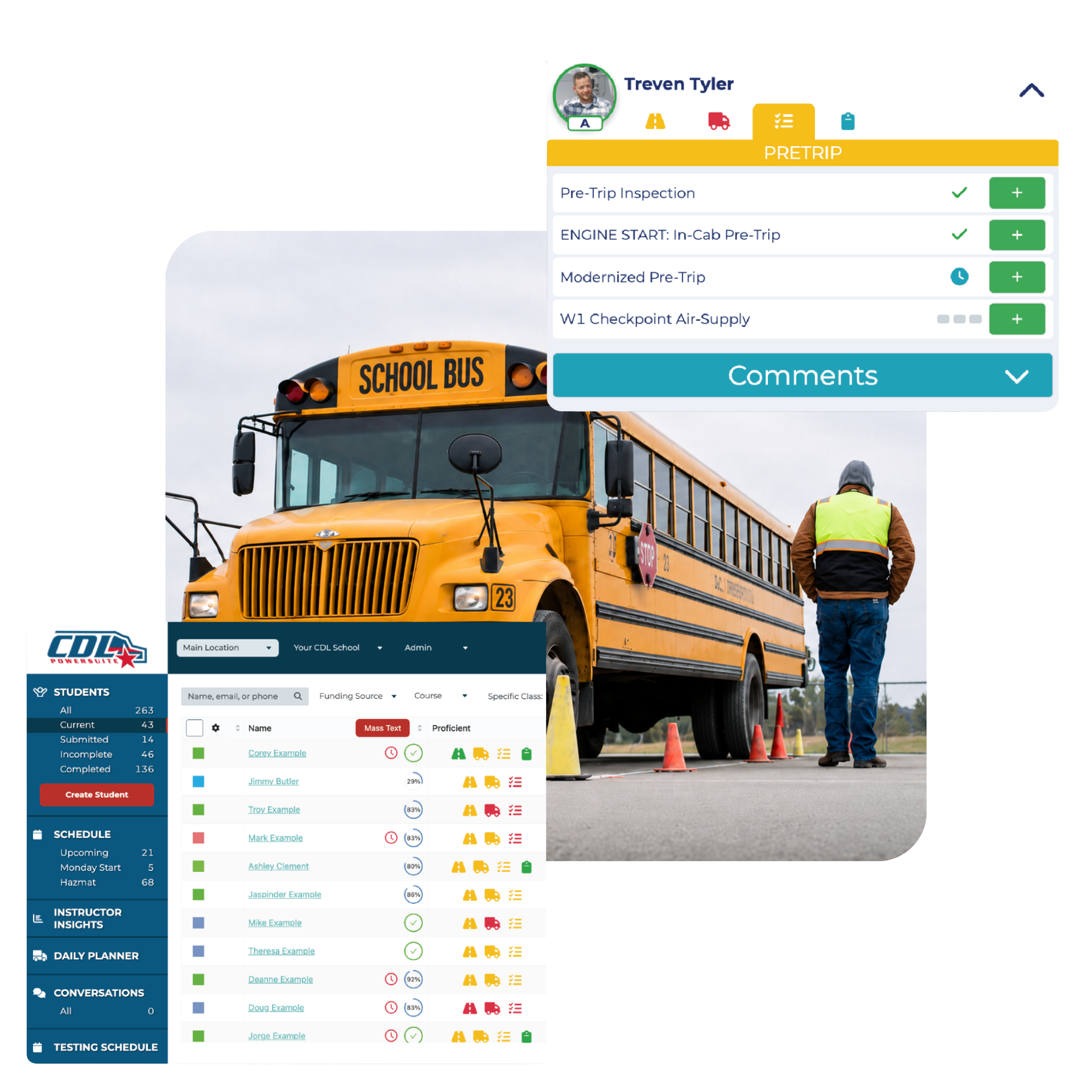
Concretely, that means: the ELDT theory curriculum for Class B, Passenger, and School Bus comes pre-built and FMCSA-aligned. The instructor portal logs BTW maneuvers, hours, and proficiency from a tablet, even offline. Trainee records, instructor qualification files, and BTW logs all live in one place. TPR submission happens at the click of a button, well inside the two-day deadline. And audit-ready reports can be generated on demand, in minutes.
None of those features remove the obligation from your district — your district remains the federally registered training provider. But each feature reduces the surface area where a busy in-house program can fail.