Helpful Information for CDL Training Providers to Share with Prospective Students

Jason Boudreau • January 10, 2025

For CDL training schools, ensuring that prospective students understand the licensing process and vehicle classifications before enrollment can set them up for success. Providing clear and accurate information helps trainees make informed decisions about their training and career path in commercial driving.

By offering this information upfront, CDL trainers can help prospective students make informed decisions about their training path, reducing confusion and increasing overall program success rates. A well-prepared student is more likely to complete the program efficiently, pass the necessary exams, and transition smoothly into a career in commercial driving. CDL training schools that proactively educate trainees before enrollment can improve student preparedness, retention, and employment outcomes.

The following sections outline the key steps to obtaining a CDL and provide an overview of the vehicles that require a CDL, which trainers can use as a guide when communicating with prospective students.

Steps to Obtaining a CDL


CDL trainers should outline the necessary steps for obtaining a Commercial Driver’s License (CDL), so trainees know what to expect before starting their training:

  1. Complete Entry-Level Driver Training (ELDT)
    Enroll in a certified training program that meets the Federal Motor Carrier Safety Administration (FMCSA) requirements.

  2. Pass a Department of Transportation (DOT) Physical
    Undergo a DOT medical examination to ensure you meet the physical requirements for commercial driving.

  3. Obtain a Commercial Learner’s Permit (CLP)Pass the required written exam at your local Department of Motor Vehicles (DMV) to receive your CLP.

  4. Enroll in a Behind-the-Wheel ELDT CDL Training Program
    Find a reputable CDL training school that provides hands-on driving instruction.

  5. Demonstrate Proficiency in ELDT Training Units
    Successfully complete all FMCSA-mandated ELDT training units and receive instructor approval for proficiency.

  6. Pass Your State’s CDL Skills Exam
    Take and pass your state’s CDL road skills test to earn your official Commercial Driver’s License.
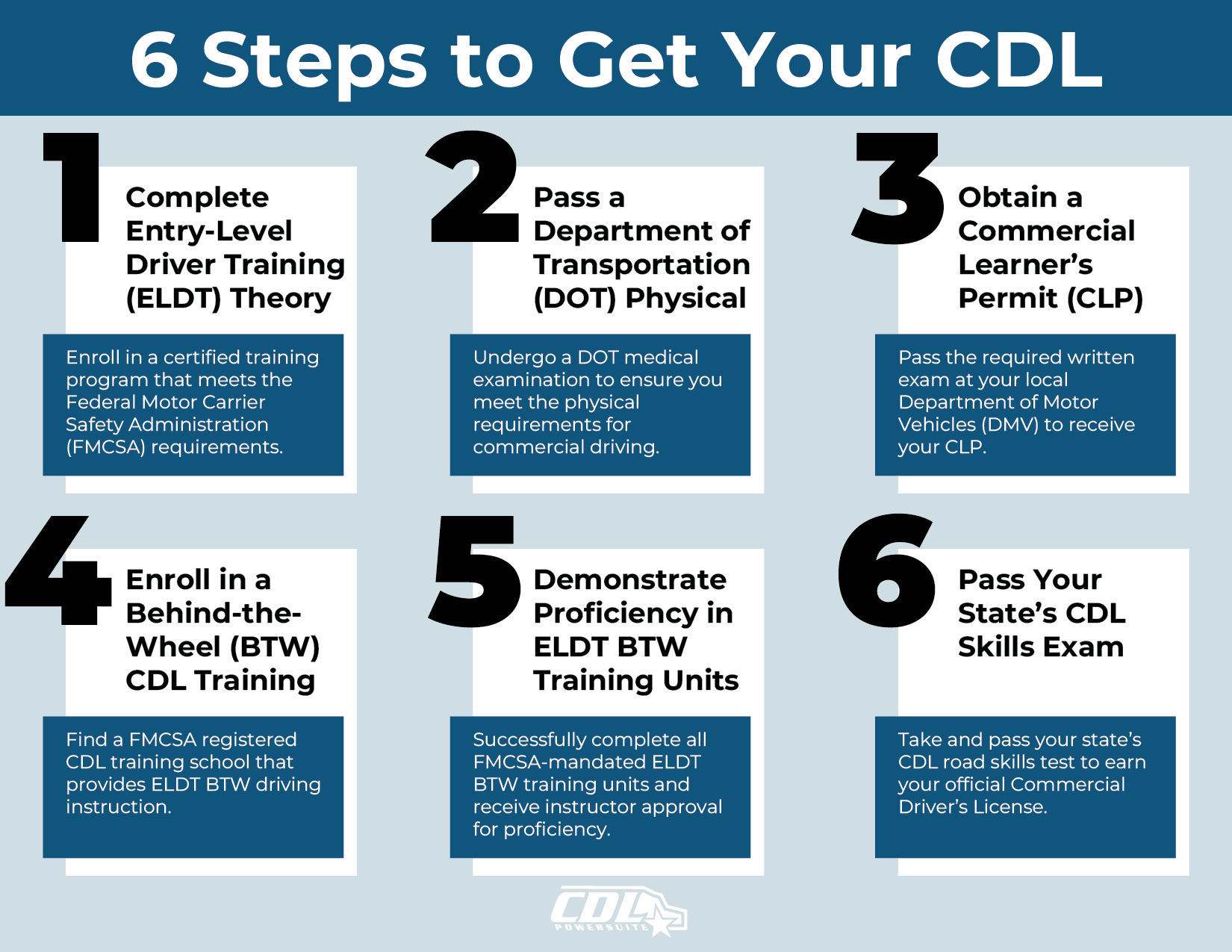
Steps Required to Get Your CDL

Summary of Vehicles Requiring a Commercial Driver’s License (CDL)


A Commercial Driver’s License (CDL) is required to operate specific types of heavy and specialized vehicles. CDLs are divided into three main classes—Class A, Class B, and Class C—each covering different vehicle types and endorsements for specialized transport.

Class A CDL

Class A CDL is required for drivers operating combination vehicles with a gross combination weight rating (GCWR) of 26,001 pounds or more, provided the towed vehicle exceeds 10,001 pounds.

  • Examples: Tractor-trailers (semi-trucks), truck and trailer combinations, tankers, livestock carriers, and flatbeds.

Class B CDL

Class B CDL is necessary for operating single vehicles with a gross vehicle weight rating (GVWR) of 26,001 pounds or more or a vehicle towing a trailer that does not exceed 10,001 pounds.

  • Examples: Box trucks, straight trucks, dump trucks, large buses (such as city and school buses), and cement mixers.

Class C CDL (with Endorsements)

Class C CDL is required for smaller commercial vehicles that:

  • Transport hazardous materials (Hazmat - H Endorsement) requiring a placard, such as fuel trucks, chemical transport vehicles, or certain delivery trucks carrying hazardous substances.
  • Carry 16 or more passengers (P Endorsement), including the driver, such as shuttle buses, small passenger vans, and certain types of school buses.

Each class of CDL may require additional endorsements for specific cargo or passenger transport, including Tanker (N), Double/Triple Trailers (T), Passenger (P), and Hazardous Materials (H) endorsements. Drivers must pass written and skills tests for the appropriate class and endorsements to legally operate these vehicles.
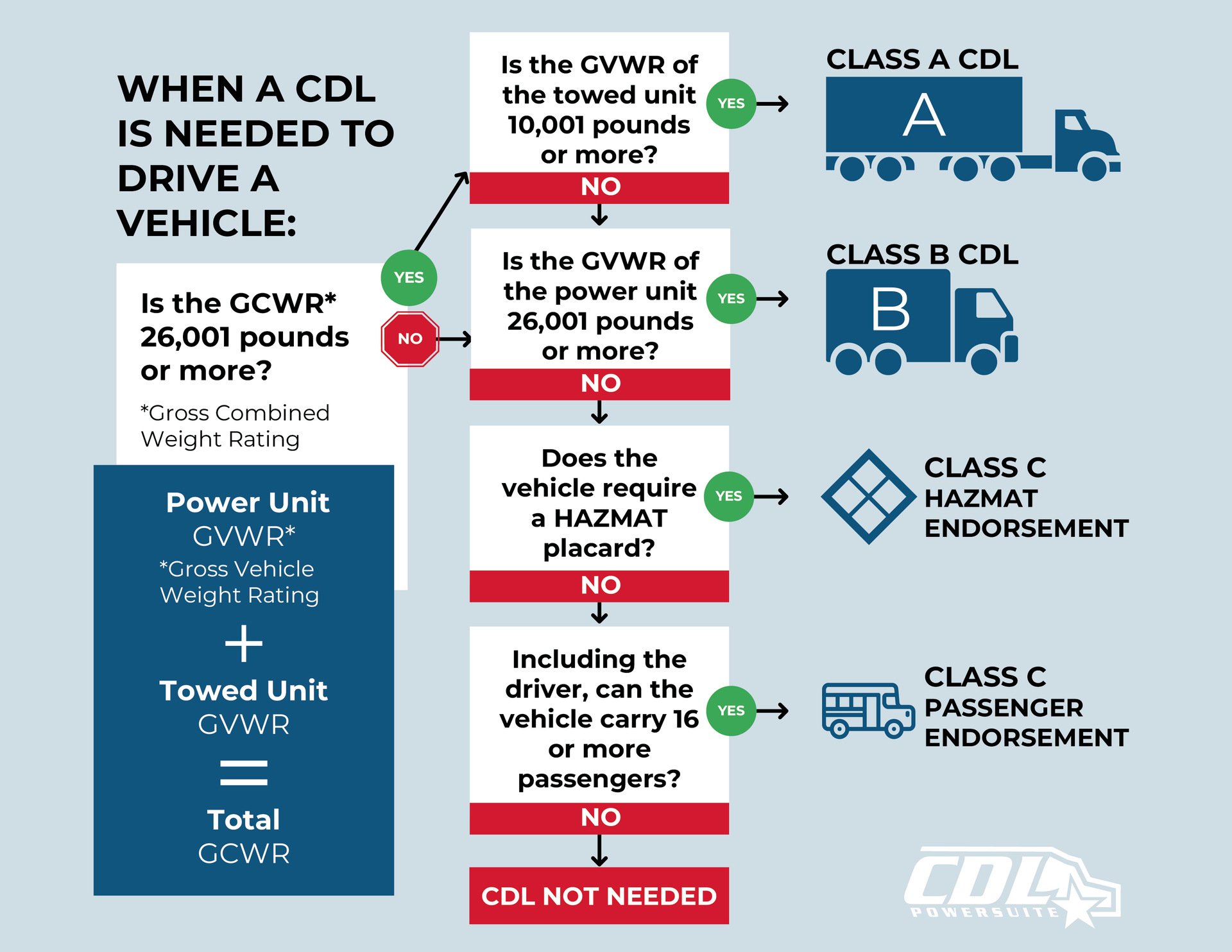
When a CDL is needed to drive a vehicle

Conclusion

By providing this information before enrollment, CDL trainers can help trainees choose the right training path, set realistic expectations, and prepare for the CDL exam process. Proper guidance at the start ensures students are confident and committed to their training, increasing their chances of success in the commercial driving industry.
August 17, 2026
Every certification your school submits to the Training Provider Registry rests on one thing: the instructor who signed off was qualified to do it. That makes instructor qualifications the single highest-stakes file in your building. When a student's record gets questioned, the school defends one certification. When an instructor's qualifications get questioned, every student that instructor ever signed off is in question at the same time. One gap, multiplied by hundreds of graduates. That is why instructor files deserve more attention than they usually get, and why "we know our people are qualified" is a sentence worth retiring. Knowing it and proving it are two different jobs. The second one is the one that counts. What qualified actually means The federal requirements come down to a few things. A behind-the-wheel instructor needs to hold a CDL of the same or higher class, with the endorsements needed for the vehicle they are teaching in, plus at least two years of experience driving that class of vehicle or two years of experience as an instructor. A clean licensing history matters too. An instructor whose CDL has been suspended, revoked, or cancelled in the recent past can be disqualified from teaching, even if their license looks valid today. Then the states add their own layer. Some require instructor licenses, background checks, or their own experience documentation on top of the federal floor. The federal rule is the minimum, and your state decides how much higher the bar sits. A school operating in more than one state can have different qualification requirements for instructors doing the same job. Qualified on paper, provable on demand Here is where schools get caught. The instructor genuinely is qualified. Twenty years behind the wheel, endorsements for everything, sharp as they come. But the file holds a photocopy of a CDL from three renewals ago and nothing else. When someone asks the school to prove the qualification, the proof is a phone call to the instructor asking them to bring their license in. A complete instructor file answers the question before anyone asks it. A current copy of the CDL with the right class and endorsements. Documentation of the experience that qualifies them, whether that is driving history or instructional history. The MVR on file and reviewed. State instructor credentials where they apply. Every requirement, matched to a document, sitting in one place. When an auditor asks, the answer takes minutes instead of a scramble. 
August 10, 2026
Every school knows the rule: the person who trains a student and the person who tests them have to be two different people. It is one of the oldest lines in third-party testing, and everyone in this industry can recite it. Knowing it happened is different from showing it happened Most schools keep the trainer and examiner separate every single time. The owner would swear to it, and they would be telling the truth. The problem is that swearing to it is all they can do. When the proof of separation lives in people's memory of who was working that day, the school has compliance that evaporates the moment memory fades or staff move on. To an auditor, a rule followed and a rule documented are two different things, and only one of them counts. The test of your documentation is simple. Pull a student file from eighteen months ago. Could a stranger look at that file and identify who trained the student and who examined them, on their own, in under a minute? If the answer requires someone to explain, the record is incomplete. The separation should be visible on the page itself. What the paper trail actually requires Two layers of documentation make the separation provable. The first is the training history. Every training event should name the instructor who delivered it. The person, specifically. A student's file should read like a roster of everyone who worked with them: which instructor ran their range sessions, which one sat with them on the road, on which dates. The complete list of who touched the student's training is the foundation, because proving the examiner was independent starts with a record of everyone who trained the student. The second is the testing record. The skills test should name the examiner just as clearly, tied to the date and the result. Put the two layers side by side and the separation proves itself. The examiner's name is absent from the training history, and the case is closed. Zero explanation, zero reconstruction, zero calls to the scheduler to vouch for who did what.