
How CDL Schools Streamline Enrollment and Planning for Professional CDL Training
Jason Boudreau • September 26, 2024

Being a CDL school owner, lead instructor, or school administrator, you know that running a smooth, efficient training program is essential to student success and the company's success. What is often overlooked in the CDL School space is the importance of streamlining daily operations like student enrollment, instructor and student schedules, and maintaining a professional operation.
Just because we use trucks that have been used forever to train students doesn't mean we must use outdated processes in-house.
At CDL PowerSuite, we believe that success starts with the first customer interaction. That journey begins with your student's enrollment process—setting the stage for success, you could call it. Student enrollment means collecting the required documents your company needs to stay compliant.
Let's discuss how to reduce that struggle, get students in the door quicker, and learn to use the same data across your system without having to manually enter it over and over again in other systems.
How Often is One Student's Data Used During Their Journey in CDL School?
- Enrollment: Per the Education board, VA, DOL or DPS, and FMCSA, you are required to collect a minimum standard of data during that enrollment process.
- Training: In most CDL schools, students are handed off to more than one instructor. As a training provider, you are required to document proficiency for each student and keep a record of it for three years. That means your instructors must have a record of everything listed in the FMCSA CFRs that are required to be marked off as proficient.
- Submitting Data: The FMCSA and, for some states, your DOL or DPS require you to submit data. The process requires someone in our office to enter 27 data points for each student who has completed training, creating an overwhelming amount of additional time spent on things not even related to training students.
CDL PowerSuite
offers powerful tools that help declutter everyone's day-to-day tasks. Let’s discuss how CDL PowerSuite drastically improves student enrollment, daily planning, and custom branding and how it can transform your operations and create a more efficient CDL Training process and professional environment for your CDL school.

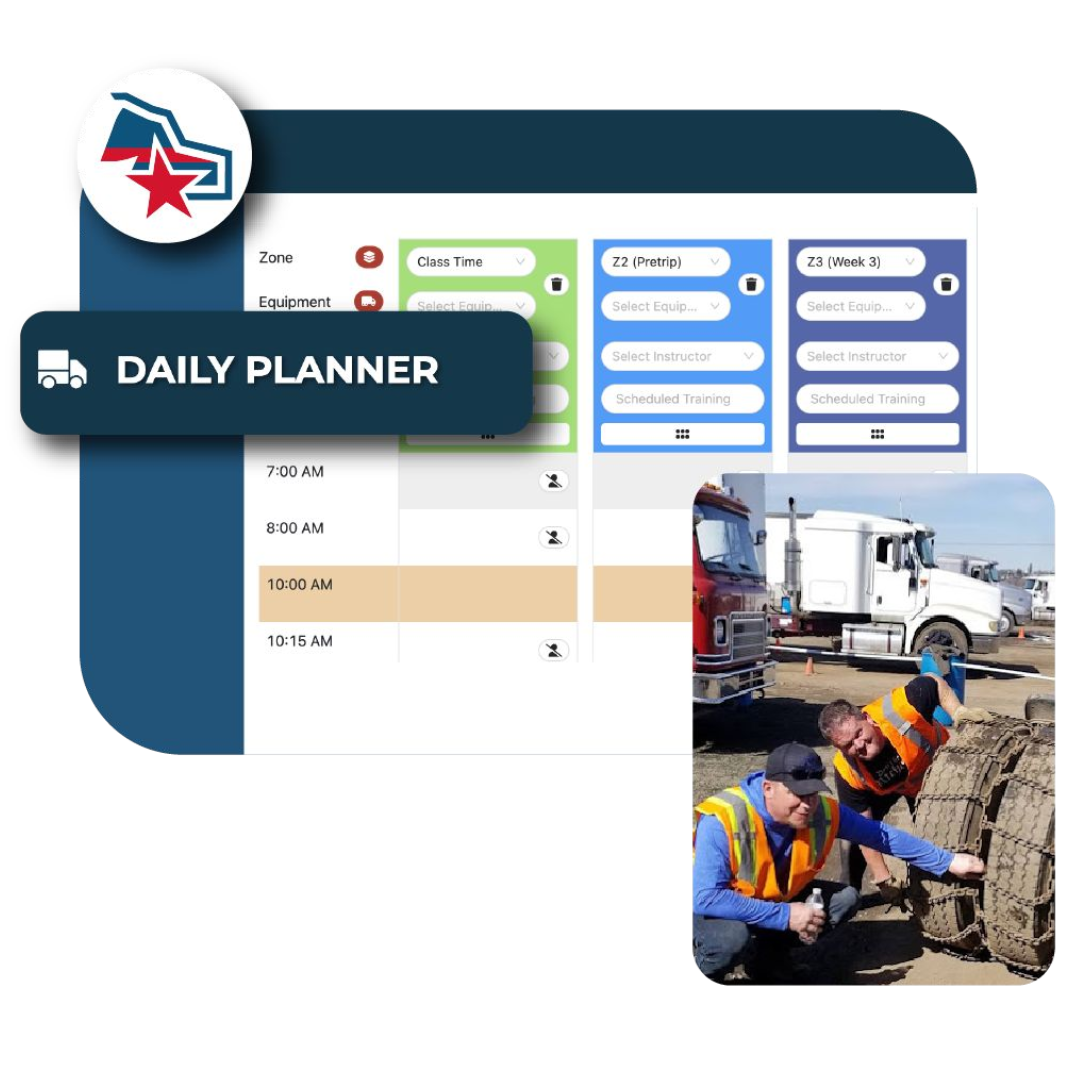
Coordinate Students, Instructors, and Your Daily Labor Costs with Our Daily Planner.
Once students are enrolled, the next challenge is coordinating schedules—ensuring that students, instructors, trucks, and classroom spaces are organized in a way that maximizes efficiency. The logistics of managing a CDL school can quickly become overwhelming and very cost prohibitive without the right tools. CDL PowerSuite’s Daily Planner is designed to streamline this process, ensuring that all resources are effectively coordinated.
How it Works:
Centralized Scheduling:
The Daily Planner allows you to organize and optimize schedules for students, instructors, trucks, and testing resources all in one place. Whether you’re managing one location or several, this feature gives you a complete overview of how resources are allocated, ensuring that nothing is overlooked.
Real-Time Updates: With real-time scheduling updates, you can make adjustments on the fly—whether it's rescheduling a test, changing an instructor’s availability, or adjusting classroom spaces. Everyone involved is immediately notified, reducing confusion and miscommunication.
Resource Optimization: By having a clear view of your entire schedule, you can optimize your resource use and control your daily labor costs—ensuring that your instructors aren’t double-booked, trucks are allocated appropriately, and testing schedules run smoothly. This maximizes the efficiency of your school’s operations and prevents unnecessary downtime.
Why It's Important:
Effective scheduling is crucial for maintaining a smooth-running CDL training program. Mismanaged schedules and operations can lead to:
- Overbooking
- Underutilized resources
- Frustrated students and staff
- Frustrated customers paying for their employees to train at your facility
- Student's first-time pass rate being compromised
With CDL PowerSuite’s Daily Planner, you can eliminate these inefficiencies and ensure that everything is perfectly coordinated, from class schedules to testing and beyond.
By streamlining scheduling, you create a more organized and professional environment. Students appreciate the reliability of a well-organized program, and staff benefit from clear expectations and seamless communication. You can identify where you need to control your daily labor costs and become more efficient. Ultimately, this leads to a more effective CDL training program for the administrators, instructors, and students. Everyone wins.
Elevate Your School’s Image with Custom Company Branding.
Professionalism doesn’t stop at efficiency—it’s also about creating a consistent and trustworthy brand image that resonates with students, instructors, and partners. CDL PowerSuite allows you to fully customize your platform with your school’s branding, ensuring that your brand’s identity shines through in every interaction.
How it Works:
Custom Branding:
CDL PowerSuite gives you the ability to integrate your school’s logo, colors, and overall branding into the platform. From the moment a student visits your enrollment page to the time they complete their training, they experience a consistent and professional brand presence.
Look Modern: Having an up-to-date design gives your school a polished, modern feel. Customize the platform for each location to reflect your branding, ensuring a fresh, contemporary look that enhances user experience while maintaining alignment with your overall brand identity and values. This approach projects professionalism and forward-thinking across all interactions.
Why It's Important:
Effective scheduling is crucial for maintaining a smooth-running CDL training program. Mismanaged schedules and operations can lead to:
- Overbooking
- Underutilized resources
- Frustrated students and staff
- Frustrated customers paying for their employees to train at your facility
- Student's first-time pass rate being compromised
Branding plays a significant role in establishing your school’s reputation. A consistent, professional brand image helps differentiate your school in a competitive market, building trust with potential students and partners. A well-branded experience reinforces your school’s credibility and professionalism.
By customizing your platform with CDL PowerSuite, you ensure that every aspect of your operation—from enrollment to communication—reflects your school’s identity and values. This not only enhances the experience for students but also sets a higher standard for your school in the eyes of the industry.

Conclusion: Create a More Professional and Efficient CDL Training Experience with CDL PowerSuite.
The Takeaways:
- Reduce data entry anytime you can, and in return your labor expenses.
- Using the same data you collected in the beginning across all processes reduces errors.
- You will reduce your new employee learning curve by having high quality process in place.
- Having all your student data at your fingertips increases efficiency for everyone in your organization.
“What are we doing today?” a student asks their instructor.
CDL School is like groundhogs every week. Your students should never show up and ask what they are doing today. It's a rinse-and-repeat process that can be easily managed with the right tools. We like to call that “A well-oiled machine,” an optimized daily planner that keeps instructors and students on track, and training modules that your instructors can grade and check off digitally with instant reporting to the office of students' progress. Aligning your resources for maximum efficiency ensures every labor dollar you spend is used wisely.
Elevating your school’s professional image puts confidence in your customer's eyes that they made the right choice.
Running a CDL school requires more than just driving around in circles - it demands efficient operations, clear communication, and a professional image in the community. CDL PowerSuite provides the tools you need to streamline your student enrollment process, optimize daily planning, and maintain a consistent, polished brand.
By simplifying student enrollment, CDL PowerSuite allows you to onboard students quickly and accurately, eliminating unnecessary paperwork and reducing the chance of errors. The Daily Planner ensures that your school runs smoothly; everyone knows what they're doing each day, and all your labor is accounted for. Real-time scheduling updates that keep everyone informed and students on track.
With custom branding options, you can present a professional, trustworthy image to students, instructors, and partners alike.
The result? A more organized, efficient, and professional training program delivers high-quality training, leaving a lasting impression in your customers' lives.
Schedule a demo today and take your training program to the next level. CDL PowerSuite will transform the way you manage your training program.